| Read Time: 1 min 29 secs |
In Wing Chun all movements are designed to be straightforward, taking as little time and effort as possible to execute, maximizing the practitioner’s ability to protect themselves while dealing the most damage to the opponent. To achieve this Wing Chun creates a set of compact gates that is mobile and economical; the body is divided up into regions or “gates” and specific movements are assigned to these regions.
For the Wing Chun practitioner it is easier to learn to protect an area or close a gate than to remember many numerous counters for a particular attack. The body is trained so that the independent movement of each limb is in due consideration to the need of its respective gate, facilitating simultaneous blocking, striking, kicking, stepping, and shifting of the body.
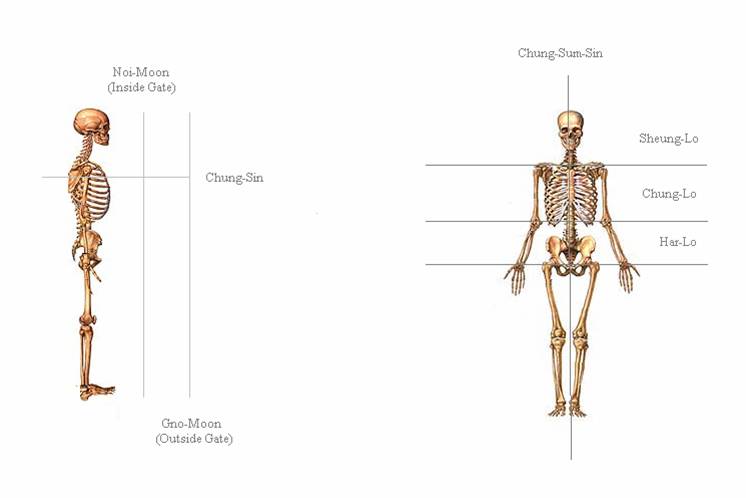
The upper gate (Sheung-Lo) ranges from the top of the head to the base of the neck. The middle gate (Chung-Lo) ranges from the collarbone to the solar plexus (or where your elbow hangs). The lower gate (Har-Lo) is from the solar plexus to the groin (or where your knuckles hang). The base gate is from the groin area to the ground. From the Wing Chun guard stance, the arms move easily from the upper gate to the middle or the lower gate. The two arms alternate, always protecting the upper and middle gates. Attacks to the lower gate are fended off using the arms or legs. Attacks to the base gate are parried off exclusively with the legs.

The four gates are divided down the centre of the body Chung-Sum-Sin. This line extends from the top of the skull, down the nose, neck, spine and between the legs and feet to the ground.
Copyright @ Craig Sands 2013
 Wing Chun Journey
You must be logged in to post a comment.