Wing Chun Stance – By Grandmaster Jim Fung

Read Time: 3 mins 15 secs
Suitable for: Beginner

The Importance of the Wing Chun Stance

Stance is one of the rudiments of the Wing Chun system. Often a student may spend many hours refining the fine points of a technique, only to find that this time has been wasted because their stance is incorrect. This is a little like spending hours working on the engine of a car and then discovering that your vehicle is not fitted with four wheels. When one has managed to develop a correct stance it is much easier to learn new techniques as a student is able to feel what is, or is not, working. Without a correct stance, nothing really works, and the student is operating by guesswork. In this article I will outline the fundamentals of the Wing Chun stance.

It is important that students develop a reasonable stance before learning bad habits that may take some time to correct. Often a student with a weak stance will fall into the trap of using brute strength to make a technique work. The more time they spend doing this, the harder it becomes for them to learn the movement correctly.

Too High or Too Low

The knees should be slightly bent to lower the center of balance and maintain stability. As with all Wing Chun this is a question of degree. It is not enough to simply bend the knees as much as possible. If one is too low in the stance this will cause the thighs to become tense. This means that the student will lack balance. The legs should work like shock absorbers absorbing force and transferring it to the ground. This is not possible if the thighs are tense. As well as being unbalanced a stance that is too low will lack mobility. If the stance is too high a student may also lack balance and therefore power. They may be pushed over, as they will find it difficult to absorb the incoming force. It is not realistic to give a certain angle as correct for the degree of bend at the knees. Body shape, flexibility and muscularity will vary between different people. By experimenting with raising and lowering the stance slightly students must find the correct height for their stance.

The most important thing is to keep one’s thighs as relaxed as possible. Sometimes students are under the illusion that the knees must be kept close together in order to guard against groin kicks. While holding the knees tightly together may defend against a snap kick delivered between the legs, the resulting lack of mobility will make the practitioner open to almost any other attack. Also you will find that you can be pushed over easily. It is important that the feet are facing slightly inwards. This helps to ensure that kicks are delivered through ones centerline, thereby protecting against groin attacks by striking rather than just blocking.

The Back

The back should be straight in order to transfer weight to the ground efficiently. If it is bent, force exerted on the practitioner may cause his/her stance to buckle. This principle may be illustrated with a plastic ruler. When a ruler is stood on end held straight, it can support a heavy weight. When the same amount of weight is placed on a slightly bent ruler, the structural integrity has been lost and it will collapse. Through correct training in Wing Chun a student will develop the muscles required for good posture.

People with back injuries will benefit from this as those muscles that protect the back are strengthened by the stance. Further health benefits may be found in the relaxation factor of the stance. People often carry tension in their shoulders. In the Wing Chun stance the chest is spread open and the shoulders are as relaxed as possible. This is not easy to achieve, but as students develop, they will attain deeper levels of relaxation. This physical skill of relaxing is a very useful tool for controlling stress. A student should feel relaxed and energised after training. If you find that you leave training sessions feeling uptight, chances are that you have been using strength rather than skill.

The Arms

The hands should be on the centre-line when in the guard position of the stance. The elbows should be forward from the body and the angle at the elbow should be the ultimate angle that is found in the basic Wing Chun positions. The hands must be relaxed with the fingers pointing forward. Thumbs should not stick up.

Thought Force

So far we have only spoken about the stance in terms of physical structure. This is only part of the picture. The skill of directing ones energy or ‘thought force’ forward through one’s centre-line is an integral part of the stance. It is not easy to teach. A student must learn to concentrate while remaining relaxed. Over years as one’s skill develops, a student will sense more energy flowing through their body as restrictions are eliminated and the channels for directing this energy open up. Perhaps the greatest benefit to be found in the training of the stance, is improved mental concentration. Learning to use one’s mind more efficiently is of even greater value than the ability to defend one’s self.

Credit:

Grandmaster Jim Fung (Fung Chuen Keung 馮傳強) was a student of Chu Shong Tin, one of the earliest disciples of Wing Chun Grandmaster Ip Man. Sadly he passed away in 2007, but he left a lasting legacy to the Wing Chun community through the creation of the Wing Chun Academy in 1973.

If you have found this investigation into the 'three teachings' and the interplay of Taoism and Buddhism you might like my article Taoism and Buddhism in Wing Chun. Click on the link here and start reading: Link

Yee Gee Kim Yeun Ma – By Darryl Moy

Read Time: 3 mins 9 secs
Suitable for: Beginner

The basic stance of Wing Chun Kuen is called the “Yee Gee Kim Yeun Ma”. To many it looks very simple and at the same time very strange in appearance. Some other styles of Kung Fu say they have similar stances, but these are very superficial comparisons. Whatever the case, this is a very important stance for all Wing Chun practitioners.

The first thing you learn when you begin Wing Chun is the basic stance ‘Yee Gee Kim Yuen Ma’.  This stance is formed by:

1. Stand straight (but relaxed) with your feet together and your hands hanging at your sides.

2. Slightly bend your knees and raise your hands up to the sides of your chest forming ‘loose’ fists. Keep your head upright and look straight ahead.

3. Keeping your back straight and head upright, open your toes outwards. This is done by swiveling on your heels. Then turn your heels out, by swiveling on the balls of your feet, until they arc slightly wider then your toes. It is important not to just twist the feet. Although the feet move, you should allow your legs to turn from the hips.

There are some very important points to look out for when forming and holding this stance. You should always keep your back straight and your chest open, but you should also be relaxed. Use just enough energy to hold the posture. This is very important as you will be using this posture for a long time (the rest of your life if you continue your training), therefore any mistakes you make can be hard to correct later or more importantly, may injure you.

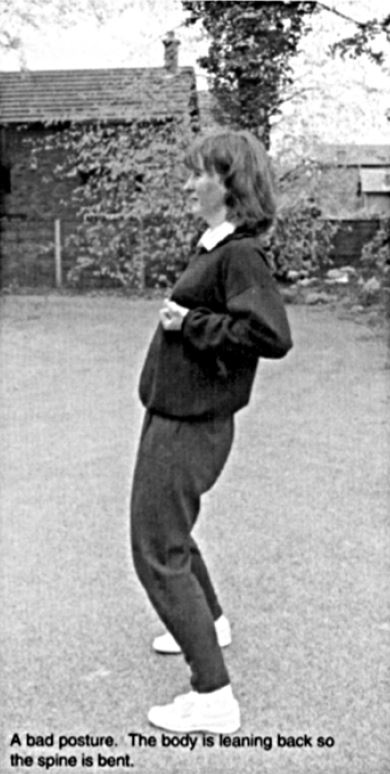
A common mistake is curving your spine backwards (see image below) or forwards. If you lean back too far, so the spine is bent, then you will be placing pressure on your abdomen, lower back, knees and ankles. You should try and avoid this as you will hurt your joints. You will also be placing pressure on your internal organs and your Dantien. This will block your Qi which may cause seemingly unrelated problems, e.g. stomach problems. Pressing your Dantien will mean you will lose too much energy and become tired and also vulnerable to injuries.

The opposite mistake, is to hunch your shoulders forwards (see image below) and so curving your spine forwards. This will place pressure on the lower pan of your neck, on your chest and abdomen. Again, if you stand like this for a long time, you may cause the same problems as above, and also place pressure on your lungs. This may cause breathing problems and tension since you arc ‘too closed”. Also, since you are restricting your breathing you will not be able to develop power in your techniques.

It has been said that the basic Wing Chun stance damages the knees. This is not true. If the stance is correct then it will in fact make you strong and healthy since it follows the same principles as other standing exercises (Zhan Zhuang) and standing meditations. Some people damage their knees because they incorrectly form and hold the stance.

If you are standing correctly, your legs will feel solid, but you should feel no twisting in any of the joints or muscles, especially in the knees or ankles. When you push your heels out when forming the stance, you should allow your legs to rotate from the hips. You do not need to squeeze your thighs in or tense up any part of your leg since the posture will make the stance solid. Never twist your joints. To see if your joints are twisted, form your stance, then relax and straighten your legs, but do not move your feet. You should find your upper body tips forwards, and your legs are turned in from the hips, but you do not feel any twisting in your joints. If you have turned your feet too far when forming your stance, you will feel twisting in your knees and ankles.

You do not in fact have to turn your feet in too much, since this is not where the strength of the stance lies. The strength comes from the thighs closing (you do not have to squeeze them in) and sinking. This closing and sinking comes from the turning of the feet and the bending of the knees. So you see, you do not have to twist your ankles and knees.

When holding your fists up at your sides do not rest them on your body, they can touch your body, but not rest on it. This way you will train your shoulders and arms. Do not pull your elbows back too much since this will again make you tense. Just make sure your chest is open but relaxed.

Remember to keep your head up and facing naturally forwards, otherwise you will not be able to breathe or sec properly. If you have found the correct stance you should find that your legs feel solid and your feet are flat on the floor. Your upper body should be totally relaxed, your spine straight, and the only pressure you can feel is in your shoulders which is caused by holding your fists and arms up.

This stance is very stable and solid. It can make you healthy and strong and is the foundation that you will build your Wing Chun on. However, when you have the stance, you will notice that with your toes in, you cannot move very easily. Thus the obvious question is how can you defend yourself in this stance? The stance trains your legs and makes you strong. When you have to defend yourself, all you do is slightly sink down, by bending your knees, and if you have trained enough your thighs will automatically close and you will have your solid base. You do not have to turn your toes in, in fact you will not have time to turn them in. Just sink down. It is very simple and very fast to do. When you can do this ask yourself whether you can defend yourself.


Credit:

Article written by Darryl Moy. Taken from the June/July, 1996/1996 (Issue 26) of Qi Magazine. Qi Magazine was founded in 1990 by Michael Tse as a means of helping his students learn more about Chinese culture. After 18 years this now has sadly ceased production.

If you found this article interesting and want to explore the Yee Gee Kim Yeun Ma Wing Chun stance in greater detail, our article "Understanding Structure - Sil Lim Tao Stance" explores the individual components of the stance.  Check it out here: Link