About Leg Techniques of Wing Chun – By Grandmaster Chow Tze Chuen

Read Time: 14 mins 13 secs
Suitable for: Intermediate

Leg techniques which is also known as kicking attacks or kicking techniques, is our Chinese martial arts’ expression of the skills of the lower limbs in the art of self defense. In my early days of learning under my teacher, the late Grandmaster Yip Man, he repeatedly mentioned that since I am short in stature and size, I should emphasize the training of the lower body (the training of the lower body covers the stances, waist usage, footwork and kicking techniques). There is a saying that is ‘in order to succeed, you have to be diligent enough and also able to endure hardship’.

The late Grandmaster Yip Man’s specialty skill in Wing Chun is that of kicking techniques. This was Grandmaster Yip’s most commonly used skill in overcoming an opponent. During the time when Grandmaster Yip was the group leader of a secret investigation team in Foshan, he already had the reputation of being able to break three wooden poles with one kick.

In another incident which occurred after Grandmaster Yip had migrated to Hong Kong in 1949, there was this incident whereby a strong young ruffian was kicked out with a single leg technique. This incident happened when Hong Kong was still an undeveloped city. Grandmaster Yip was staying in an area with extremely poor living conditions. The living conditions were so terrible that there was no pipe-in water and families had to retrieve water from a public tap by the roadside. There was an incident once whereby Grandmaster Yip was standing in the queue waiting for his turn to fill his bucket with water. Suddenly there was this young muscular chap who thinking that he would use his brawn to get his way decided to cut queue. Seeing this ruffian take undue advantage of the situation Grandmaster Yip went up to him to have a word with him on his unreasonable behavior since everyone else was queuing for their turn. However the young ruffian not only did not want to listen he decided to teach Grandmaster Yip a lesson. In that split second before the ruffian’s blow could land, Grandmaster Yip had already used his Piercing Bridge hand technique to intercept the blow and simultaneously used a front kick to drop the ruffian. This incident illustrates the depth of Grandmaster Yip Man’s skill in the Wing Chun leg techniques.

Although I did not personally witnessed the above incident and only got to know it through words of mouth, during the course of Grandmaster Yip’s teaching, there was once where he demonstrated this technique to me and it left a vivid impression because of its realistic simulation. Especially memorable is Grandmaster Yip’s demonstration of Kwan Sao with a kick. Quickly as a bolt of lighting Grandmaster Yip was able to simultaneously strike with his kick and neutralize with his hands without having to extricate his kicking leg first in preparation or moving his body. Grandmaster Yip’s fierce kick came through so quickly to my stomach that I was not able to stop it yet Grandmaster’s control was so good that he only touch me gently without injuring me. Grandmaster Yip’s precise and nimble control of his kicking power enabled him to demonstrate to me this aspect of the Wing Chun skills.

Another time Grandmaster Yip was demonstrating how to use one’s leg as though it was a hand. He instructed me to extend the Tan Sao posture and then Grandmaster Yip used the Fook Gerk to place on my Tan Sao. Thereafter Grandmaster Yip with a downward retracting motion was able to pull me off-balance and caused me to bend my knees and fell to the ground. This was my personal experience of Grandmaster Yip’s maxim of using the leg as if using a hand.

Grandmaster Yip’s total confidence in the use of Wing Chun’s leg techniques can be seen in another incident. During the early days when Wing Chun was gaining a foothold in Hong Kong, it was common for other martial arts styles to come to try out the new kid on the block by holding a competition whether by invitation or direct challenge. During this time, another Chinese style wanted to test out our Wing Chun school and a competition was organized accordingly. However Grandmaster Yip would only agree to the competition readily on condition that kicking techniques could also be used. Unfortunately the competition was called off in the end for some unknown reason. Notwithstanding the cancellation of the competition, this reflected Grandmaster Yip’s confidence in Wing Chun kicking techniques.

It is only half a century later, when I got to know that fellow Wing Chun practitioners have the intention of publishing a special issue of “Ip Man’s Wing Chun – 50th Anniversary Memorial Journal” that I take this opportunity to briefly touch on the topic of Wing Chun’s leg techniques.

“Southern Fists, Northern Kicks” ?

There is a saying in Chinese martial arts that goes “Southern Fists, Northern Kicks”. This means that southern Chinese martial arts are famed for the use of the hands whereas northern Chinese martial arts are well versed in the use of the legs. Wing Chun is a southern Chinese martial arts that is well known for skillful use of the hands which alone is sufficient to overcome an opponent. From this a misunderstanding has risen that Wing Chun is lacking in kicking skills and its kicks are lacking as compared to the more well known northern Chinese styles which specializes in this area. Actually in the attack and defense skills of Wing Chun there is a special aspect and that is the kicking techniques which is used in combination with the principles of centerline and concurrent striking and defense.

Leg techniques are such a good winning edge that a boxing maxim says that the hands are like two swinging doors to open up the opponent to be destroyed with the devastating kicks. Furthermore there is a proverb that says the fists strikes 30% of the time whereas the kicks are used during the remaining 70%. The role and purpose of Wing Chun leg techniques can be classified into 3 parts :

(a) Making the weak to overcome the strong. The legs are naturally longer and also stronger than the hands. This gives an advantage to the user of kicks in overcoming an opponent. The use of kicks is especially suited for those of small stature and consequently have problem overcoming a much bigger and taller person. Wing Chun as an internal martial art uses kicks that are economical and do not go above the height of the waist. Thus, to launch kicks by shifting, jumping and leaping are not the kicking techniques of Wing Chun.

(b) Giving the opponent an unexpected attack. The Wing Chun practitioner can use his leg techniques within the distance of a single arm bridge to coordinate with the use of the two hands to strike. This requires the use of the hands to distract the opponent while adjusting the lower limbs to strike without alerting the opponent. This is in line with the famous Chinese 36 Strategies of “feint to the east, attack to the west” to steal the thunder on the opponent.

(c) Using the leg to neutralize the opponent’s leg. The Wing Chun practitioner who is using the leg techniques for attack and defense must take note that the upper and middle body zone is the province of the hands with the legs used in the lower body zone to counterattack. When using the legs one must use the legs to neutralize and concurrently in combination with the hands counterattack the opponent’s leg attacks to the lower body zone with one’s own kicks. Only then can one fulfil the requirement of the Wing Chun maxim “when you want to strike to the top (of the body zone), I strike to the bottom; when you strike to the bottom, I will strike to the top”.

Shadow-less Kicking Method

Wing Chun’s kicking attack is not only swift and speedy like lightning but precise and unpredictable. Wing Chun’s shadow-less kick is so called because it is sudden and quick as a flash of lighting; so quick that the opponent does not even have the opportunity to react to the kick. This is how the name “Mo Ying Gerk” (in Cantonese, Shadow-less Kick) came about.

The ability to execute a Wing Chun shadow-less kick is dependent on the following primary requirements :

(a) The attacking motion must be minimal and tight to be sudden and non-telegraphic, yet the reach must be wide and far to retain the power of the movement.

(b) Secondly the movements must be linked by maintaining the flexibility of the posture, stances and footwork. This can only be achieved if one is soft and relaxed.

To achieve minimal attacking motion, the following principles must be observed.

(1) No Movement of the Upper Body and Drawing Back of Leg

When one is using leg techniques the upper body must not move and the kicking leg must be able to kick out straightaway without the need to draw back first. It is common to see martial arts practitioners tilt the body when kicking. Wing Chun’s requirement is that the upper body must remain motionless.

(2) Simultaneous usage of arms and legs

Wing Chun’s leg techniques maintains that “without hands, there are no legs”. This means that if one were to unleash a kick there should be an accompanying appropriate hand technique. One should never hastily use the kicks on their own. With the accompanying use of the hands one can “feint to the east, attack to the west” to simultaneously attack and defense. Only then can one achieve victory.

(3) Leg should not exceed waist height

The kicking leg should never exceed the waist height in order to maintain a tight and close attack and keep the body balanced when attacking with a kick. The correct place to attack with the legs will be discussed below.

(4) Using the leg like a hand

Grandmaster Yip would constantly remind us during training sessions that we should use our legs as if we were using our hands. The requirement for using the hands in Wing Chun is that they must be acutely sensitive and agile, able to react at the correct moment, guarding the centerline closely, maintaining a state of natural relaxation, and sink and drop the shoulders. The elbows and shoulder are likened the knees and the kua respectively. These are the requirements for using the leg techniques in Wing Chun.

Wing Chun’s Kicking Techniques

The fundamental principle in using power in Wing Chun is to relax. One’s leg power must be natural. Before executing a kick the Wing Chun practitioner must first relax the waist and kua, sink the breath to the Dan Tian. Only then will the power reside in the waist and then extend to the knees before reaching the lower thigh and finally reaching the heel. When a kick reaches the target or is being intercepted by the opponent one should be immediately retract back the leg.

Wing Chun’s kicking method is to let the heel do the leading but within this there can be found hooking, stamping, sweeping and flicking. These are the expressions of kicking that can be found in the Wing Chun Wooden Dummy to deal with different situations. The following are the kicks found in the Wooden Dummy :

1. Kwan Sao –Side Kick (Caption 5)
2. Tan Da – Slanting Kick to the Knee
3. Tan Da – Front Kick
4. Chuen Kiu – Front Kick
5. Kwan Sao – Trampling Kick
6. Pak Sao – Detaining Kick
7. Kwan Sao – Low Side Kick
8. Pak Sao –Slanting Kick to the Knee
9. Gaun Sao – Sweeping Kick (Caption 6)
10. Jut Sao – Front Kick (Caption 7)
11. Tan Da – Low Front Kick
12. Pak/Tan – Slanting Kick (Caption 8)
13. Lap Da – Slanting Kick (Caption 9)

The main focus of the attacking leg is the body’s middle and lower zone. The middle zone includes Dan Tian, tail bone, groin, floating ribs and solar plexus. The bottom zone includes upper inner thighs, knees, ankles, instep, calves and shins. Appended below is classification table for Wing Chun leg techniques.

Kicking TechniqueKicking MethodKicking Target
Stomp – using the heel to thrustKwan Sao – Side Kick
Kwan Sao – Low Side Kick
Dan Tian, ribs, groin, knees
Tan Da – Slanting Kick
Pak Sao – Slanting Kick to Knee
Knees
Tan Da – Front Kick
Pak/Tan – Slanting Kick
Solar plexus, Dan Tian, groin
Chuen Kiu – Front Kick
Jut Sao – Front Kick
Lap Da – Slanting Kick
Dan Tian, groin, solar plexus
Tan Da – Low Front KickKnees, calves
Hook – using the foot to unbalance and cause the opponent to fallPak Da – Detaining KickAnkle
Trample – using the entire foot or the bottom of the foot to forcefully stomp the opponentKwan Sao – Trampling KickShins, lower thigh, upper inner thigh
Sweep – using the shin to kick the opponent’s lower bodyGaun Sao – Sweeping KickCalves, ankle
Hook – using the sole or tip to kick the opponent’s groin or tailboneTan Da – Front Kick
Pak/Tan – Slanting Kick
Groin, tailbone

The use of leg to neutralize a kick involves Bong Gerk, Fook Gerk and Jing Gerk.

Essentials of Leg Training

When using legs on the opponent, it is very important to be fast and agile. It is because there is a delay between the time the kicking foot is lifted off the ground to kick and placing it back on to the ground again. And this momentary delay also affects the body’s ability to move fast. If this is the case, leg attacks not only cannot hurt the opponents but also give the opponent a chance to counter-attack. Before trying to attempting to use kicking, one should train the legs first. Before training the leg, one should train footwork first. The training of footwork is beyond the scope of this article. If there is an opportunity, I will touch the topic on footwork in another article. One should strive to achieve kicks which are flexible and supple.

It is because when one is slow in using kicks to attack than it will be difficult to overcome the opponent. It is only when one has attained the stage of supple and flexibility should one try to achieve a high degree of accuracy. Only when one has trained the footwork to be stable, able to control the facing direction and distribution of weight placement between the legs smoothly, is one able to kick swiftly. Otherwise one will be slow and clumsy.

The Chum Kiu form is used to train the placement of the body weight of the Side Stance (Pien Sun Ma) and Frontal Stance (Ching Sun Ma) to be entirely on the rear leg. The front leg should just lightly contact the ground. This trains the stance and footwork to be stable, which is the fundamental requirement when learning to kick.

Wing Chun’s leg techniques has no somersault, leaping or jumping kicks. Kicks are aimed only at the middle or lower body zone. When training Wing Chun kicks there is no need to follow the methods of northern style kicks; it is sufficient to adhere to Wing Chun’s methods which are :
1. Solo leg kicking method
2. Sticking leg (Chi Gerk)
3. Kicking Dummy

(1) Solo leg kicking method

All Wing Chun practitioners who first take up kicking must learn to kick smoothly. This requires numerous repetitions. Without this hard work, the Wing Chun practitioner will not be able to generate power. Different styles have different kicking practices. The following are Wing Chun’s solo kicking practice methods :
a) Using the right leg as your center of gravity, stand upright and have the right hand extended in the Biu Jee Sao posture.
b) Then have the left leg face forward and execute a front kick. Kick to the extreme extension of the kicking leg to generate power so that upon conclusion of the kick, the kicking leg will automatically retract back to the original position. Thereafter the retracting leg traces a small circle before executing another front kick.
c) Repeat number (b), there are no limit to the number of times one can do this.
d) Continue to keep the left leg up in the air without touching the ground, turn the body and change into Kwan Sao with Wang Gerk.
e) The right leg continues to stand in an upright posture while supporting the entire body’s weight. Then using the whole body as an axle, kick out the right leg once after each turn of the body. Again there are no limits to how many times one can turn in training.
f) Reverse number (a) and (e) for the left and right leg.
Note that while practicing kicking, the upper body has to remain still.

(2) Sticking Leg (Chi Gerk)

Sticking leg is the second level skill of training in Wing Chun’s leg techniques. There are 3 reasons for training the sticking leg. One of them is to cultivate the supporting leg balance. The second reason is to train the waist, kua and knee to become supple and smooth. Lastly, the reason for training sticking leg is to train the sensitivity of both legs and achieve the stage of using hands and legs interchangeably.

(3) Kicking Dummy

Kicking dummy is a summary of the previously listed kicking techniques in this article consolidated to form a separate dummy form from the normal 8-section Wooden Dummy form. This separate section of kicking dummy was created solely to train the kicks. The main motive is to train waist, stance, stepping, hand strike and kicking to move as one.

The use of kicking techniques has to be realized in sticking hand but because leg techniques is not easy to control its power, the potential for injuring the partner is there. In the beginning of my teaching, I was hesitant to include leg technique within the training of sticking hands. It was later through Grandmaster’s encouragement that assured me of the value of leg techniques in practical usage. The assurance from Grandmaster Yip changed my way of teaching my students.

Credit:

Chow Tze Chuen. Wing Chun Chuen Kwoon. June 2000. Grandmaster Chow Tze Chuen ( 鄒子傳) was a direct student of Wing Chun Grandmaster Ip Man. Sadly he passed away in 2017, but he left a lasting legacy to the Wing Chun community through his role as Honorary President of International Wing Chun Organisation (IWCO).

Related Reading:


The Dynamic Kicking of the Wing Chun System – By Grandmaster Jim Fung

Read Time: 6 mins 17 secs
Suitable for: Intermediate

Wing Chun’s Diverse Range of Kicks

Many people are of the opinion that the Wing Chun System comprises primarily of arm movements with a few kicks. They do not realize that the Wing Chun system contains a greater variety of kicks than a large number of popular martial arts systems known for their kicking. There are two reasons for this misunderstanding. Firstly, because the hand techniques of the Wing Chun system are so efficient for self-defense, the kicks are not seen as often as the arms. Secondly, most Hong Kong Wing Chun masters do not normally teach students kicking until they have been learning for a good number of years. Students are in fact being prepared to do kicking from the day they start Wing Chun when they learn the Wing Chun stance. Mastery of the stance is an important prerequisite for kicking as it gives both balance and power.

The Importance of the Stance

While practicing kicking without first developing a solid stance will increase force in the kicking to a degree (through repetition training) full potential will not be realised. Wing Chun works on the premise that force is maximised through full use of body mass and acceleration. To achieve this Wing Chun locks the body in as one unit at the waist. If during a kick the body becomes unlocked then the full mass won’t be utilised and full potential will not be achieved. There are no short cuts: Full potential cannot be achieved without the proper stance. Using the Wing Chun hook kick as an example, a student with a poor stance will find that they lack balance and are unable to transfer their full body weight to the kick as the upper and lower halves of the body will be working out of sync. This is due to lack of coordination and muscle control. The result will be poor balance making it difficult to kick with speed as too much energy is used to keep balance, making the movement slow and clumsy and places them in a vulnerable position.

Wing Chun Kicking Characteristics

Wing Chun kicking techniques adhere to the Wing Chun principles of directness, simplicity, practicality, minimum use of brute strength and economy of movement. As with all techniques in Wing Chun, kicking keeps to the same principles as arms, kicks are fast and direct, stable and non-telegraphic, uncomplicated, practical, controlled and uncommitted, low risk and done in the most powerful way through the most efficient utilization of body weight.

Fast and Direct

All kicks are executed directly to the target with one quick movement taking the shortest time and distance. An example of this is the thrust kick to the groin area. This kick is executed by driving the knee towards the target whilst maintaining the angle in the leg from the stance. As the leg is making contact with the target it extends, the knee drives force through the heel; thus utilising the full mass and momentum of the body. Compare this kick to one involving two movements where the body is rotated and the leg is cocked first, before extending to strike. Not only does the kick take more time and distance to reach the target, but as it has been cocked the momentum of the body has also stopped; therefore the amount of force generated becomes limited to the strength of the muscles in the leg.

Stable and Non-Telegraphic

In delivering the Wing Chun kick the body is always kept upright, it does not lean forward, backward or sideways. If your stance is not stable and you lean back for example, your force is being directed away from the target; your bodyweight is travelling in a backward direction, which negates the force of the strike. If weight needs to be transferred to the supporting leg prior to the kick, then this shift will precede the kick telegraphing your intentions. As the body moves much slower than limbs do, the more body movement involved in the kick the slower the kick will be and the more telegraphic. Kicking from an upright position not only maintains balance, but also makes it very difficult for the attacker to detect your incoming kick; due to the lack of body movement. It is of utmost importance not to telegraph your intention to attack in a real fight.

Uncomplicated

As the entire Wing Chun system is geared towards realistic self-defense, any techniques that require complicated movements are excluded from the system. It is believed that the more complicated a technique, the more difficult it is to apply in a real fighting situation. This is simply because complicated techniques require several movements to complete which makes it harder and more time consuming to apply and gives the opponent a better chance of retaliating by intercepting or countering the movement.

Practical and Low Risk

Kicks requiring a lot of room to apply such as turning, flying and jumping kicks are risky and impractical to apply in real situations; as clothing or environment may restrict the application of such a kick. These kicks shorten ones reach and also expose parts of your body unnecessarily i.e., high kicks to the head, which leave your groin and midsection open to attack or take you off the ground are considered very risky. They make you vulnerable to having your legs grabbed or losing your balance. The higher the kick the more power is diminished in the kick so that even if the kick was to land it probably wouldn’t have the power to knock a person out as the body mass is utilised less effectively the higher you kick. Wing Chun would not execute kicks to the head. Instead, Wing Chun makes use of hand striking to attack an opponent’s upper body, while legs are used to attack an opponent’s lower body. This is because the body is designed with the arms nearer to the attacker’s head and legs nearer attacker’s legs therefore making it more logical and practical to attack those areas with those limbs. For this reason kicks above waist height have been removed from the Wing Chun system as they put the practitioner to unnecessary effort and risk. Low kicks executed to the attackers waist and below are harder to intercept and more powerful. The legendary Grandmaster Yip Man once said: ‘Why jump up and try to kick someone in the head when it is much quicker and safer to execute a fast direct punch to the attackers face’.

Controlled

Wing Chun kicks are designed in such a way to be used in close range and in conjunction with the arms. Therefore a properly trained Wing Chun student would not generally execute a kick without first controlling the opponent’s arms, unless the kick is used for the purpose of engaging the opponent ie bridging the gap. By controlling the attacker’s arms the Wing Chun exponent is able to control the attackers balance, latch them into the kick and increase the force of impact. Having this control of the attackers weight will reduce the chance of the opponent countering or avoiding the kick, ensuring that the kick will land.

Uncommitted

A wide swinging type of kick is like an all or nothing type of attack. If you miss your target and do not knock out your assailant you may be vulnerable in the moment before you regain balance and execute the follow up attack. Committed kicks are like wide swinging punches, once the movement is started and the target is missed the body momentum carries you through and the upswing of the whole movement must be completed before the next is initiated. You are then committed to following that course of action making it difficult to change to another movement if the strike misses the mark or is countered. In contrast all Wing Chun kicks are short and sharp, landing with a fast powerful impact. A well a well trained Wing Chun student is able to deliver a series of very powerful close range uncommitted kicks that can easily be executed one after another in rapid succession. For example: chain kicking, where a low heel kick continues into a hook kick in an efficient and economical manner. There is no room in the system for movements that cannot be part of a multiple series of kicks executed in a matter of seconds.

Utilize Body Momentum in the Most Powerful Way

Through a combination of determination force, body coordination and speed, Wing Chun students attain a high level of explosive force on impact from in their kicks, even at very close quarters. Determination force relies on total mind/body coordination and augments the power given to the explosive impact of a kick. Mental power draws force potential from all parts of the body and focuses it with great concentration and momentum to the striking area. Kicks are executed without having to rely on back swings to get momentum up. With an untrained kick for example, the top of the body swings in the opposite direction to the kicking movement which means the directional force of the kick is negated. The Wing Chun student is taught that arms and legs must be coordinated to travel in the same direction to the target. All available force is directed from the upright stance along the centerline thus maximizing body momentum. Newton’s laws of physics states that the impulse of a force is a combination of both the mass of the striking body and the change of the speed that it undergoes. That is, force is a product of mass and its acceleration. Wing Chun applies this physical principle by teaching that the whole body mass must go onto the target, accelerating from the static stance to maximum speed upon impact and beyond. In this way the greatest possible momentum is transferred into the force of the strike. Wing Chun utilises its kicks in the most economical, efficient and practical way possible by keeping the movements compact and direct at the target with full body mass behind the kick to achieve maximum result with the least effort.

Credit:

Grandmaster Jim Fung (Fung Chuen Keung 馮傳強) was a student of Chu Shong Tin, one of the earliest disciples of Wing Chun Grandmaster Ip Man. Sadly he passed away in 2007, but he left a lasting legacy to the Wing Chun community through the creation of the Wing Chun Academy in 1973.

Effective Kicking – By Grandmaster Jim Fung

Read Time: 4 mins 21 secs
Suitable for: Beginner

School Background

I began training in Wing Chun Kung Fu in Hong Kong nearly forty years ago. Twenty five years ago I established a martial arts centre in Adelaide, Australia. As demand grew my school has expanded throughout Australia and the rest of the world. Since 1988 my school (International Wing Chun) has been accredited by the Australian Government to run full time courses. Students who study at this school are paid study allowances by the Government. Hundreds of students travel from all over the world to Australia to train in my school on work and study visas. Enrolment dates are at the start of the year and also mid-way through.

To date International Wing Chun Academy is the only martial arts organisation in Australia to be recognised in this way. One of the main reasons why I began training full time professional students is that through these dedicated pupils I am able to pass on the traditional and genuine Wing Chun system, also this offers an ideal opportunity for those who want a lifetime commitment to the art and be able to make a living out of ‘preaching’ this incredible art. I consider these students to be my ‘closed door’ pupils and hope that my school will continue to expand and become something of a modern day Shaolin Temple preserving and spreading the genuine art of Wing Chun.

Practicality over Visual Appeal

In over 30 years I have been exposed to nearly all styles of martial art, and have met and exchanged views with many top martial artists. I have come to the conclusion that Wing Chun differs from most styles in it’s primary emphasis on practicality. All movements that are not completely useful have been eliminated, and this is one reason why Wing Chun does not look flashy. People who are accustomed to seeing or doing the spectacular movements of other styles find that Wing Chun does not look impressive. To them it looks too simple, the movements are too small, too direct and relaxed to make a visual impression. The Wing Chun movements can not be judged by looking at them – the best way is to be on the receiving end of these deceptively innocent movements, and to feel and imagine the enormous impact the Wing Chun strikes and deflections can have.

Among all the Chinese Kung Fu, Wing Chun is spoken of as the least “beautiful” but the most effective. Contrary to popular opinion, not all styles of martial art are related to self defence. Some styles are designed and practised with an emphasis on artistic or sporting, rather than fighting aspects. Several styles and schools gear their training towards tournaments or Olympic performances, which involves completely different training than for self defence. All genuine styles that are learnt under a qualified master have benefits to offer. The martial art student should discover what they seek in a martial art by clearly analysing the movements.

Wing Chun’s Effectiveness

Wing Chun has many diverse aspects and benefits, however these do not detract from its essential emphasis on effectiveness. In general most fights start and end with hand contact, usually punching and grappling. With proper training, kicking can be very useful, for example, when dealing with someone who can easily match you with their hands. Wing Chun trains you to use the legs in combination with your arms, adding more possibility of striking and controlling the opponent. Wing Chun emphasises low kicks because we believe them to be faster, easier to apply and less risky than high kicks. It is most important to keep your balance when kicking, otherwise the opponent may be able to grab your leg, or move in and push you over.

The Wing Chun Stance in a Fight

The Wing Chun stance teaches you how to keep your balance. In training, always practise your stance, and do all kicking from the stance. In a real situation, bend the knees slightly to lower the centre of gravity and allow ease of leg movement, always apply your internal contraction to hold the upper and lower body together as one unit, and keep the back up straight. Of course, your guard must be up. If you are arguing with someone, and you feel that a fight might break out, always keep your hands up near the front of the body for speed of movement. Don’t have your hands behind your back, in pockets, or down at your sides – it takes too long to guard and strike.

Wing Chun’s Kicks

Wing Chun basic kicks include the low heel kick, stamping kick, low side kick, snap kick, medium thrusting kick and hook kick. At an advanced level students are taught leg deflection and trapping, involving sweeping, leg locking and attacks such as “Chain Kicking” – a rapid barrage of three or more powerful low kicks, delivered in under a second to targets such as the knee, groin and midsection. In many of the Wing Chun kicks, the heel is used for striking, because this will result in maximum impact to the opponent, with the minimum risk of injury to your foot.

The Wing Chun Stance and Defence Against Kicks

The stance teaches you how to kicks without telegraphing, and this makes your low kicking even harder for the opponent to stop. Most people find it hard to stop a fast, powerful low kick. When your stance develops you are taught in Wing Chun how to use your legs to guard the lower half of the body. Because the kicking movements of Wing Chun are simple, they are easy to learn and apply. This is most important in a real situation. Low kicking is practical in any type of clothing and regardless of the physical surroundings, because it is compact and direct. From the front on stance with the weight evenly distributed over both feet, either leg can be easily used for kicking.

The Effectiveness of Wing Chun Kicks

The Wing Chun kicks save time and conserve energy, and can be very powerful. They can be used to bridge the gap between you and the opponent. If someone shapes up, and is outside your striking range, a kick can be used, usually followed by striking and hand trapping. Wing Chun also trains you to use your legs at very close range. Because you learn to kick and punch at the same time, while using the other arm for deflection or trapping, you must be able to deliver a kick at punching range.

All the Wing Chun kicks are simple, direct and practical, and therefore could be used in many real self-defence situations.

Bruce Lee’s Hollywood Kicking

Through training in the same Wing Chun school in Hong Kong, I was acquainted with the late Bruce Lee. On a trip to Hong Kong in the early 1970’s I ran into him, and the conversation turned to his spectacular kicking. He re-iterated the point that it was for the movies only, and in a real fight he would always use the Wing Chun low kicks.

Credit:

Grandmaster Jim Fung (Fung Chuen Keung 馮傳強) was a student of Chu Shong Tin, one of the earliest disciples of Wing Chun Grandmaster Ip Man. Sadly he passed away in 2007, but he left a lasting legacy to the Wing Chun community through the creation of the Wing Chun Academy in 1973.

If you are interested in delving deeper into kicking within the Wing Chun system, then why not check out this other great article from Grandmaster Jim Fung "The Dynamic Kicking of the Wing Chun System" here: Link

Wing Chun Stance – By Grandmaster Jim Fung

Read Time: 3 mins 15 secs
Suitable for: Beginner

The Importance of the Wing Chun Stance

Stance is one of the rudiments of the Wing Chun system. Often a student may spend many hours refining the fine points of a technique, only to find that this time has been wasted because their stance is incorrect. This is a little like spending hours working on the engine of a car and then discovering that your vehicle is not fitted with four wheels. When one has managed to develop a correct stance it is much easier to learn new techniques as a student is able to feel what is, or is not, working. Without a correct stance, nothing really works, and the student is operating by guesswork. In this article I will outline the fundamentals of the Wing Chun stance.

It is important that students develop a reasonable stance before learning bad habits that may take some time to correct. Often a student with a weak stance will fall into the trap of using brute strength to make a technique work. The more time they spend doing this, the harder it becomes for them to learn the movement correctly.

Too High or Too Low

The knees should be slightly bent to lower the center of balance and maintain stability. As with all Wing Chun this is a question of degree. It is not enough to simply bend the knees as much as possible. If one is too low in the stance this will cause the thighs to become tense. This means that the student will lack balance. The legs should work like shock absorbers absorbing force and transferring it to the ground. This is not possible if the thighs are tense. As well as being unbalanced a stance that is too low will lack mobility. If the stance is too high a student may also lack balance and therefore power. They may be pushed over, as they will find it difficult to absorb the incoming force. It is not realistic to give a certain angle as correct for the degree of bend at the knees. Body shape, flexibility and muscularity will vary between different people. By experimenting with raising and lowering the stance slightly students must find the correct height for their stance.

The most important thing is to keep one’s thighs as relaxed as possible. Sometimes students are under the illusion that the knees must be kept close together in order to guard against groin kicks. While holding the knees tightly together may defend against a snap kick delivered between the legs, the resulting lack of mobility will make the practitioner open to almost any other attack. Also you will find that you can be pushed over easily. It is important that the feet are facing slightly inwards. This helps to ensure that kicks are delivered through ones centerline, thereby protecting against groin attacks by striking rather than just blocking.

The Back

The back should be straight in order to transfer weight to the ground efficiently. If it is bent, force exerted on the practitioner may cause his/her stance to buckle. This principle may be illustrated with a plastic ruler. When a ruler is stood on end held straight, it can support a heavy weight. When the same amount of weight is placed on a slightly bent ruler, the structural integrity has been lost and it will collapse. Through correct training in Wing Chun a student will develop the muscles required for good posture.

People with back injuries will benefit from this as those muscles that protect the back are strengthened by the stance. Further health benefits may be found in the relaxation factor of the stance. People often carry tension in their shoulders. In the Wing Chun stance the chest is spread open and the shoulders are as relaxed as possible. This is not easy to achieve, but as students develop, they will attain deeper levels of relaxation. This physical skill of relaxing is a very useful tool for controlling stress. A student should feel relaxed and energised after training. If you find that you leave training sessions feeling uptight, chances are that you have been using strength rather than skill.

The Arms

The hands should be on the centre-line when in the guard position of the stance. The elbows should be forward from the body and the angle at the elbow should be the ultimate angle that is found in the basic Wing Chun positions. The hands must be relaxed with the fingers pointing forward. Thumbs should not stick up.

Thought Force

So far we have only spoken about the stance in terms of physical structure. This is only part of the picture. The skill of directing ones energy or ‘thought force’ forward through one’s centre-line is an integral part of the stance. It is not easy to teach. A student must learn to concentrate while remaining relaxed. Over years as one’s skill develops, a student will sense more energy flowing through their body as restrictions are eliminated and the channels for directing this energy open up. Perhaps the greatest benefit to be found in the training of the stance, is improved mental concentration. Learning to use one’s mind more efficiently is of even greater value than the ability to defend one’s self.

Credit:

Grandmaster Jim Fung (Fung Chuen Keung 馮傳強) was a student of Chu Shong Tin, one of the earliest disciples of Wing Chun Grandmaster Ip Man. Sadly he passed away in 2007, but he left a lasting legacy to the Wing Chun community through the creation of the Wing Chun Academy in 1973.

If you have found this investigation into the 'three teachings' and the interplay of Taoism and Buddhism you might like my article Taoism and Buddhism in Wing Chun. Click on the link here and start reading: Link

What Yip Man Taught Me About Speed – Duncan Leung

Read Time: 3 mins 4 secs
Suitable for: Intermediate

Recently an acquaintance gave me a copy of QiGong / KungFu Magazine, the March 1999 issue, which featured an article written by Master Ron Heimberger. My friend did not quite understand the principles that Master Heimberger was trying to elucidate. Because of my background as a private student of Yip Man, and my subsequent involvement in Wing Chun Kung Fu, he thought I might be able to throw some light on the subject. I ask the reader’s indulgence for my attempt to explain what Yip Man taught me. 

Since my English is not very good, I read the article several times. I am glad that Master Heimberger is kind enough to take the time to educate the public. If all Wing Chun instructors possessed an open mind like him, amenable to reason, and were willing to go to the trouble of explaining their ideas and experiences to others, I am sure it would benefit everyone interested in the art. However, there are some parts in Master Heimberger’s article with which I do not agree. Certain points that the author makes are somewhat obscure to me, particularly his references to Jacob Bronowski and Albert Einstein. For example, Master Heimberger mentions that Bronowski — commenting on Newton’s Second Law of Motion — said that force equals mass times acceleration squared. This confuses me because, as I understand it, Newton’s Second Law states that S F = ma, which does not square acceleration.

Since Mr. Heimberger discusses speed in Wing Chun, I would like to take the liberty to share my interpretation of the principles and theories about speed based on what Sifu Yip Man taught me and on my own experience. Naturally, what I write here is filtered through my own perceptions and prejudices; I certainly do not claim to speak for the Wing Chun family, and would welcome any correction that is offered. That certainly would help me improve. It is my hope that many Wing Chun members will share their ideas with all of us, no matter who they have learned from. The experience of using the Wing Chun techniques in fighting is what counts. After all, no single fight is the same. We can always learn something new, or — win or lose — find out something from each encounter.

What makes the Wing Chun style so interesting is that one does not have to rely on physical build, but on a logical sequence of economic movements. Certainly speed is extremely important in fighting. However, no matter how hard one trains, how long one works to improve, there are always physical limitations. You can always meet someone faster than you. Some people are simply born with more talent. Wing Chun allows one the possibility of overcoming an opponent’s inherent superior speed by applying the principles of the art. Yip Man taught that in Wing Chun, there are several types of speed. If you cannot overcome your opponent with one type of speed, you can beat him with another. In other words, if you can apply the Wing Chun theory of speed, you can actually become faster. In this regard, there are four areas of concern:

(1) SPEED OF TRAVELING

This is the type of speed we normally refer to, that is, a punch or kick, a speed which speed can be calculated in feet per second. With consistent practice, one gradually improves the speed of the movement.

(2) SPEED OF DISTANCE

Wing Chun straight-line theory states simply that a straight line between two points is the shortest distance. Therefore, punching straight is shorter and quicker than a hook punch or a swing. To bring your foot with a roundhouse kick to the head covers a greater distance than a shorter and quicker punch to the head. It is the same as trying to punch to the shin; that is, it is much shorter and faster to kick to the shin. To use an analogy: if you and I both stand in front of a building and have a race to the back door and you go around the building while I go straight through the building from the front door to the back door, you may be the faster runner, but I may get there before you because I have less distance to cover.

(3) SPEED OF READINESS

From a resting standing position, when one tries to throw a heavy punch or tries to kick with power, it is typical to cock back the leg or arm before executing the movement. This not only telegraphs the move, but also wastes valuable time in the extra motion. In Wing Chun, the power is not generated just by the moving hand or leg, so there is no need to cock. One uses the other side of the body to pull back as he or she rotates to push out the punch or kick simultaneously. For example, if one is going to throw a left punch, one initiates power by pulling the right arm and shoulder back as fast as he or she can, while punching with the left hand at the same time.

(4) SPEED OF REACTION

In general, people spend most of their time practicing their techniques in their forms alone until they are very good with all the techniques, but in actual combat the application is ineffective. This is like learning to ride a bicycle by sitting in a chair moving the legs and arms simulating the bicycle experience. When that person actually tries to ride on the bicycle, he or she will surely fall. This is because the proper reflexes and feeling of balance have not been developed. Yip Man used to say if you want to learn to swim, go down to the water; don’t just move your arms and legs and think that you are a swimmer. A fight requires at least two people. You can train and fight with yourself all day long, but unless you apply the techniques with another person, you will not get very far.

Wing Chun has only three forms. After learning and understanding the first form, one trains with Chi Sau, which requires two people, and from which one develops the feeling of contact and reflex. Then there are the technique drills which also takes two people. When you work with the drills over and over, month in and month out, they become habit, second nature. When an attack comes you will react to it without thinking. Fighting happens so very fast and you may be upset, angry, unprepared or even scared. There is no time to think.

Such are the Wing Chun Theories of Speed that I learned from Yip Man.

Credit:

This is a much reprinted essay by Sifu Duncan Leung, student of Yip Man. I have attributed it to Sifu Leung himself as there is no other clear associated source.

Related Reading:


Yee Gee Kim Yeun Ma – By Darryl Moy

Read Time: 3 mins 9 secs
Suitable for: Beginner

The basic stance of Wing Chun Kuen is called the “Yee Gee Kim Yeun Ma”. To many it looks very simple and at the same time very strange in appearance. Some other styles of Kung Fu say they have similar stances, but these are very superficial comparisons. Whatever the case, this is a very important stance for all Wing Chun practitioners.

The first thing you learn when you begin Wing Chun is the basic stance ‘Yee Gee Kim Yuen Ma’.  This stance is formed by:

1. Stand straight (but relaxed) with your feet together and your hands hanging at your sides.

2. Slightly bend your knees and raise your hands up to the sides of your chest forming ‘loose’ fists. Keep your head upright and look straight ahead.

3. Keeping your back straight and head upright, open your toes outwards. This is done by swiveling on your heels. Then turn your heels out, by swiveling on the balls of your feet, until they arc slightly wider then your toes. It is important not to just twist the feet. Although the feet move, you should allow your legs to turn from the hips.

There are some very important points to look out for when forming and holding this stance. You should always keep your back straight and your chest open, but you should also be relaxed. Use just enough energy to hold the posture. This is very important as you will be using this posture for a long time (the rest of your life if you continue your training), therefore any mistakes you make can be hard to correct later or more importantly, may injure you.

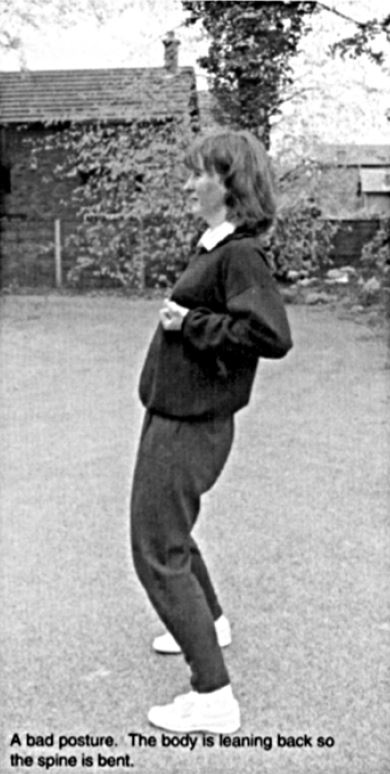
A common mistake is curving your spine backwards (see image below) or forwards. If you lean back too far, so the spine is bent, then you will be placing pressure on your abdomen, lower back, knees and ankles. You should try and avoid this as you will hurt your joints. You will also be placing pressure on your internal organs and your Dantien. This will block your Qi which may cause seemingly unrelated problems, e.g. stomach problems. Pressing your Dantien will mean you will lose too much energy and become tired and also vulnerable to injuries.

The opposite mistake, is to hunch your shoulders forwards (see image below) and so curving your spine forwards. This will place pressure on the lower pan of your neck, on your chest and abdomen. Again, if you stand like this for a long time, you may cause the same problems as above, and also place pressure on your lungs. This may cause breathing problems and tension since you arc ‘too closed”. Also, since you are restricting your breathing you will not be able to develop power in your techniques.

It has been said that the basic Wing Chun stance damages the knees. This is not true. If the stance is correct then it will in fact make you strong and healthy since it follows the same principles as other standing exercises (Zhan Zhuang) and standing meditations. Some people damage their knees because they incorrectly form and hold the stance.

If you are standing correctly, your legs will feel solid, but you should feel no twisting in any of the joints or muscles, especially in the knees or ankles. When you push your heels out when forming the stance, you should allow your legs to rotate from the hips. You do not need to squeeze your thighs in or tense up any part of your leg since the posture will make the stance solid. Never twist your joints. To see if your joints are twisted, form your stance, then relax and straighten your legs, but do not move your feet. You should find your upper body tips forwards, and your legs are turned in from the hips, but you do not feel any twisting in your joints. If you have turned your feet too far when forming your stance, you will feel twisting in your knees and ankles.

You do not in fact have to turn your feet in too much, since this is not where the strength of the stance lies. The strength comes from the thighs closing (you do not have to squeeze them in) and sinking. This closing and sinking comes from the turning of the feet and the bending of the knees. So you see, you do not have to twist your ankles and knees.

When holding your fists up at your sides do not rest them on your body, they can touch your body, but not rest on it. This way you will train your shoulders and arms. Do not pull your elbows back too much since this will again make you tense. Just make sure your chest is open but relaxed.

Remember to keep your head up and facing naturally forwards, otherwise you will not be able to breathe or sec properly. If you have found the correct stance you should find that your legs feel solid and your feet are flat on the floor. Your upper body should be totally relaxed, your spine straight, and the only pressure you can feel is in your shoulders which is caused by holding your fists and arms up.

This stance is very stable and solid. It can make you healthy and strong and is the foundation that you will build your Wing Chun on. However, when you have the stance, you will notice that with your toes in, you cannot move very easily. Thus the obvious question is how can you defend yourself in this stance? The stance trains your legs and makes you strong. When you have to defend yourself, all you do is slightly sink down, by bending your knees, and if you have trained enough your thighs will automatically close and you will have your solid base. You do not have to turn your toes in, in fact you will not have time to turn them in. Just sink down. It is very simple and very fast to do. When you can do this ask yourself whether you can defend yourself.


Credit:

Article written by Darryl Moy. Taken from the June/July, 1996/1996 (Issue 26) of Qi Magazine. Qi Magazine was founded in 1990 by Michael Tse as a means of helping his students learn more about Chinese culture. After 18 years this now has sadly ceased production.

If you found this article interesting and want to explore the Yee Gee Kim Yeun Ma Wing Chun stance in greater detail, our article "Understanding Structure - Sil Lim Tao Stance" explores the individual components of the stance.  Check it out here: Link 

The Wing Chun Fighting Mentality – Ron Heimberger

Read Time: 2 mins 26 secs
Suitable for: Beginner

“The superior man, when resting in safety, does not forget that danger may come. When in a state of security he does not forget the possibility of ruin. When all is orderly, he does not forget that disorder may come. Thus his person is not endangered, and his States and all their clans are preserved.”

—Kung Fu Tze

To understand and fully utilize self defense principles you must understand the fighting mentality.  When two people of equal skill fight, what is it that pushes one past the other to victory?  The answer is the fighting mentality.  The fighting mentality is a combination of several principles that allow you to survive an encounter.  Now, don’t misunderstand this concept to imply that you should be cruel or mean.  However, you must use a certain level of intensity and focus to win a fight. 

We call the first principle of this concept the fighting spirit.  Simply stated, when you fight, you must be willing to go one step above whatever level your opponent is using.  You simply must not try to fight at a lower level of intensity than your attacker.  If your attacker means to simply hurt you; you must be willing to injure him.   If he is seeking to do serious bodily injury or even kill you; you must be willing to do the same to him.  The problem is, determining at what level your attacker is at.  The only true answer is that you don’t know.  Therefore, you must fight at the highest level and then use your best judgment to determine when your attacker is no longer a threat to you.

Although most fights end with someone quitting before serious injury occurs you cannot rely on this response when your life is threatened.  There is too much at stake.  It can be understood that there are three ways in which a fight can be ended.  They are:  You can take your opponent’s air or ability to breathe.  You can cause your attacker to lose his consciousness.  Finally, you can take his life.

You can accomplish this end by aiming your attacks primarily at your attacker’s throat.  When you attack the throat with a strike it causes an involuntary choking reaction.  Your attacker will try to ease this choking response by grasping for his throat.  This would provide you with an opportunity to escape.  Moreover, if his airway is not cleared he will lose consciousness and might even die.

Although, the throat is clearly the weakest spot on the body, it might not be immediately open to attack or other targets might be more vulnerable based upon the situation.  You might also choose to attack the eyes, which would make it very difficult for your opponent to continue an assault.  Also, you can attack the knees with a kick that would drop your opponent to the ground and allow you to escape without the danger of pursuit.  Finally, you can attack the groin which can cause considerable pain.  However, remember that pain alone does not guarantee that your attacker will stop.

Now, I have defined the fighting mentality or the mentality that you need in order to successfully defend yourself.  I must leave you with a strong warning.  The fighting mentality is only used in a violent confrontation that is forced upon you.  You must never use this mentality outside of that situation.  If you did so it would cause you to be overly aggressive and you might even wind up in jail.  However, when you are attacked and you have no other means of escape the fighting mentality might offer the final key to your survival.


About Ron Heimberger

Master Ron Heimberger was a direct disciple of Grandmaster Ip Ching, the youngest son of the famous Grandmaster Ip Man. Sadly, he passed away in 2008. He had been a Director of The Ip Ching Wing Chun Athletic Association in the USA, and Director of the Wing Chun Kung Fu Council. He has left a Wing Chun Kung Fu legacy in his written works, and through his students within the United States, South America, Europe, and the Middle East.

Relaxation: Wing Chun’s First Weapon – Ron Heimberger

Read Time: 3 mins 10 secs
Suitable for: Beginner

Whenever you begin a new undertaking you may often ask yourself, “Where do I start?” At first, the task may seem daunting and you may be tempted to give it up before the real fun of attaining skill has been realized. Self-doubt is the nagging enemy of every new beginner – no matter the activity. So, how do we effectively set ourselves onto the path of discovery with full confidence and the mindset to persevere? It’s easy: just relax

The art of Wing Chun brings an individual into a fast realization of their inherent power and creative ability by first teaching them the principle of Relaxation. It is your ability to dynamically and properly relax that releases your body’s natural abilities and frees your mind from the shackles of rigidity. By fully expressing this principle you will find the resources to fuel your ability to completely protect yourself, as well as perform well in every aspect of your life. Now, what exactly does relaxation have to do with the self-protection environment?

When you find yourself in a threatening situation, your first thought is probably not to relax, but it should be. The principle of relaxation makes you able to fully protect yourself for many reasons. One reason is that when you are relaxed you reduce the risk of being hurt when your opponent strikes you or wrenches your joints. When you match force against force you accept the full force of the blow or joint wrenching movement. But when you relax, the part of the body that is struck or being manipulated can move with the blows and the wrenching movements without accepting your opponent’s full force. Imagine dropping a large stone into a pool of water. The water just moves out of the way and then surrounds the rock. But if the water is frozen, the ice will crack and shatter. Similarly, if you are tense when your opponent strikes you or tries to wrench your limbs, the force will do much more damage to your body than if you were relaxed.

Perhaps the most important reason you should practice relaxation is that it will help you develop explosive, deadly power. An equation taken from Newton’s Second Law of Thermodynamics states that Mass times Acceleration equals Power. So, to increase your power you must increase both your body’s available mass and speed, with an eye toward developing the ability to utilize every ounce of available mass behind each movement and move with maximum explosive acceleration. But how do you gain the ability to do this?

Have you ever tried to pick up a sleeping baby? If you have, you know the baby seemed heavier than when it was awake. This is because the baby was relaxed and all of its body mass was settled. Similarly, when you relax, your muscles seem to have more mass because they are being allowed to make each movement with every cell of muscle tissue settled and available. When you tense your arm during a movement you artificially support the tissue and disallow its most efficient operation.

Relaxation also increases your power by increasing your speed. When your muscles are tense they pull against each other and hold each other back. Fighting with tension in your muscles is like driving a car with one foot on the accelerator and one foot on the brake. Tension in your muscles slows your attack and retards the power. But when your muscles are relaxed your movements will have much greater speed, and therefore much greater power.

Relaxation creates an environment for the muscles in your body to operate in their most efficient manner. Your muscle tissue will be settled and will smoothly transfer the increased mass to the target. The muscle fibers will be able to accelerate each movement without hesitation, making you move at maximum speed. The two together – mass and speed – when utilized in an attacking movement such as a punch, creates a powerful momentum that then translates to the target in the form of a devastating kinetic energy powerful enough to stop any attacker.

Beyond even the physical benefits that proper relaxation grants you are the even more important mental powers that will be realized through this practice. When your mind is calmed and alert through conscious relaxation you will find that your awareness is significantly expanded, your ability to process sensory information will become quicker, and your decisions will become more powerful and fluid – without the mental hesitation often experienced.

To help you relax when you find yourself in a confrontation, take a deep breath. This will help you relax both physically and mentally. This is a tactic used by public speakers, professional athletes, and even soldiers. When you take a deep breath you send your brain more oxygen and you are able to think more clearly. Increased oxygen also alleviates the feeling of panic and stimulates the flow of adrenaline. Taking a deep breath will help you to relax your muscles so you can move with greater power. In a fight, you will do the same things you do when you practice, so get in the habit of relaxing in a confrontation by relaxing during your practice time.

When your ability to relax has become intrinsic you will have found the key that Wing Chun has given you to unlock your power and give you full freedom of expression. You will find that your mind is not easily disturbed, and will experience situations that used to be crises as now only challenges that are easily surmounted.


About Ron Heimberger

Master Ron Heimberger was a direct disciple of Grandmaster Ip Ching, the youngest son of the famous Grandmaster Ip Man. Sadly, he passed away in 2008. He had been a Director of The Ip Ching Wing Chun Athletic Association in the USA, and Director of the Wing Chun Kung Fu Council. He has left a Wing Chun Kung Fu legacy in his written works, and through his students within the United States, South America, Europe, and the Middle East.

If you are interested in exploring the role of relaxation further, why not check out our article "The relaxation vs structure dilemma and the use of gravity in Wing Chun" here: Link