“They expelled all the toxins from the body, and constantly preserved their true energy. Having accumulated these effects over a long time, their bodies were transformed, and they became immortals.”
The Daoist arts of health and longevity are founded on the principle of the dual cultivation of mind and body. An unhealthy body cannot support a clear mind and an egotistical mind will weaken a healthy body. Clearing the mind and strengthening the body are equally important whether our goal is health, mental well being, or spiritual enlightenment. As students of the arts of health and longevity, how should we go about cultivating both mind and body?
Today, cultivating the body is usually associated with techniques of Qigong, Daoist callisthenics, and internal martial arts such as taijiquan and baguazhang. On the other hand, cultivating the mind is usually associated with long sessions of sitting meditation. Westerners, who are more comfortable with movement than stillness, have gravitated more toward the techniques of cultivating the body than those of cultivating the mind.
In Europe and especially North America, the dropout rate in meditation classes is higher than that of say, taijiquan. The perceived differences between cultivating mind and body, moreover, have separated practitioners into those who prefer “mind only” and those who prefer “body only” programs of training. This is unfortunate, because to benefit fully from the Daoist arts of health, the training of body and mind must be integrated in a balanced and harmonious way.
Knowing that a strong spine, articulated joints, flexible tendons, and relaxed muscles are necessary for practising sitting meditation, the Daoists have recommended that new students start their training with a gentle physical exercise such as taijiquan. Once the body becomes soft and relaxed a form of meditation known as quiet sitting is introduced. In this way, the practitioner can work on emptying the mind without being distracted by backaches and cramped muscles. As the mind begins to empty its thoughts, the practitioner will become more comfortable with stillness. Subsequently, when he or she practises the physical techniques, thinking will stop spontaneously, body and mind will be united, and stillness will become the guiding force behind movement.
As the practitioner progresses into increasingly challenging physical movements designed to massage the internal organs and open blockages in the circulatory system, the techniques of cultivating the mind also change. Because the physical foundation has been built, meditation can now be used to gather and conserve internal energy or Qi. Once internal energy is gathered, physical movements are used to circulate it through the body thus, alternating movement and stillness and simultaneously cultivating mind and body, health, longevity, and spiritual enlightenment can be attained.
Attitude and lifestyle are important in cultivating mind and body. This is where the wisdom of the Daoist sages can be a valuable guide. Many people do not see the connection between classroom training and daily lifestyle. Consequently, they lose what was gathered in the training session the very next day. The Daoist sages tell us that too much thinking can dissipate energy, too much desire can confuse the mind, and too much activity can harm the body. Therefore, those who cultivate mind and body should refrain from a lifestyle of excess.
Many practitioners of the Daoist arts of health think that they can indulge in spending energy, believing that energy can always be replenished by practising Qigong or meditation. This is unfortunate, because if energy gathered is spent immediately, there will be no net improvement of health in the long run.
Attitude can also affect how much we can benefit from the Daoist arts of health. Negative and competitive attitudes are not conducive to learning. Neither is the desire for fame and power. The Daoist sages and founders of the arts of longevity lived a simple life and were at peace with themselves. They had few desires and did not seek social recognition and political power. They were not excited by gains or worried over losses. They did not compete with anyone; therefore no one competed with them. Because they integrated the practices of strengthening the body and clearing the mind with their lifestyle, they were able to attain the highest levels of physical health, mental wellbeing and spiritual development. In the words of the Triplex Unity of the foremost Daoist texts of the arts of longevity, these sages
“Carried the mystery and embraced the ultimate reality… They covered their traces and hid from the world. They conserved their energy and nourished the spirit… The sweet nectar moistened their skin and flesh. Their tendons and bones were soft and strong. They expelled all the toxins from the body, and constantly preserved their true energy. Having accumulated these effects over a long time, their bodies were transformed, and they became immortals.”
Credit:
Article written by Eva Wong. Taken from the March/April, 1998 (Issue 36) of Qi Magazine. Qi Magazine was founded in 1990 by Michael Tse as a means of helping his students learn more about Chinese culture. After 18 years this now has sadly ceased production. Eva Wong is the author of Seven Taoist Master, Cultivating Stillness along with many other titles.
If you are interested in exploring the role of Daoism (also called Taoism) further within Wing Chun then check out our article "Taoism and Buddhism in Wing Chun" here: Link
The basic stance of Wing Chun Kuen is called the “Yee Gee Kim Yeun Ma”. To many it looks very simple and at the same time very strange in appearance. Some other styles of Kung Fu say they have similar stances, but these are very superficial comparisons. Whatever the case, this is a very important stance for all Wing Chun practitioners.
The first thing you learn when you begin Wing Chun is the basic stance ‘Yee Gee Kim Yuen Ma’. This stance is formed by:
1. Stand straight (but relaxed) with your feet together and your hands hanging at your sides.
2. Slightly bend your knees and raise your hands up to the sides of your chest forming ‘loose’ fists. Keep your head upright and look straight ahead.
3. Keeping your back straight and head upright, open your toes outwards. This is done by swiveling on your heels. Then turn your heels out, by swiveling on the balls of your feet, until they arc slightly wider then your toes. It is important not to just twist the feet. Although the feet move, you should allow your legs to turn from the hips.
There are some very important points to look out for when forming and holding this stance. You should always keep your back straight and your chest open, but you should also be relaxed. Use just enough energy to hold the posture. This is very important as you will be using this posture for a long time (the rest of your life if you continue your training), therefore any mistakes you make can be hard to correct later or more importantly, may injure you.
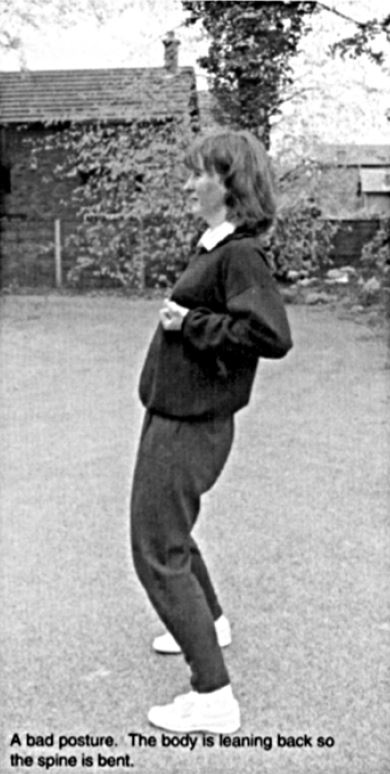
A common mistake is curving your spine backwards (see image below) or forwards. If you lean back too far, so the spine is bent, then you will be placing pressure on your abdomen, lower back, knees and ankles. You should try and avoid this as you will hurt your joints. You will also be placing pressure on your internal organs and your Dantien. This will block your Qi which may cause seemingly unrelated problems, e.g. stomach problems. Pressing your Dantien will mean you will lose too much energy and become tired and also vulnerable to injuries.
The opposite mistake, is to hunch your shoulders forwards (see image below) and so curving your spine forwards. This will place pressure on the lower pan of your neck, on your chest and abdomen. Again, if you stand like this for a long time, you may cause the same problems as above, and also place pressure on your lungs. This may cause breathing problems and tension since you arc ‘too closed”. Also, since you are restricting your breathing you will not be able to develop power in your techniques.
It has been said that the basic Wing Chun stance damages the knees. This is not true. If the stance is correct then it will in fact make you strong and healthy since it follows the same principles as other standing exercises (Zhan Zhuang) and standing meditations. Some people damage their knees because they incorrectly form and hold the stance.
If you are standing correctly, your legs will feel solid, but you should feel no twisting in any of the joints or muscles, especially in the knees or ankles. When you push your heels out when forming the stance, you should allow your legs to rotate from the hips. You do not need to squeeze your thighs in or tense up any part of your leg since the posture will make the stance solid. Never twist your joints. To see if your joints are twisted, form your stance, then relax and straighten your legs, but do not move your feet. You should find your upper body tips forwards, and your legs are turned in from the hips, but you do not feel any twisting in your joints. If you have turned your feet too far when forming your stance, you will feel twisting in your knees and ankles.
You do not in fact have to turn your feet in too much, since this is not where the strength of the stance lies. The strength comes from the thighs closing (you do not have to squeeze them in) and sinking. This closing and sinking comes from the turning of the feet and the bending of the knees. So you see, you do not have to twist your ankles and knees.
When holding your fists up at your sides do not rest them on your body, they can touch your body, but not rest on it. This way you will train your shoulders and arms. Do not pull your elbows back too much since this will again make you tense. Just make sure your chest is open but relaxed.
Remember to keep your head up and facing naturally forwards, otherwise you will not be able to breathe or sec properly. If you have found the correct stance you should find that your legs feel solid and your feet are flat on the floor. Your upper body should be totally relaxed, your spine straight, and the only pressure you can feel is in your shoulders which is caused by holding your fists and arms up.
This stance is very stable and solid. It can make you healthy and strong and is the foundation that you will build your Wing Chun on. However, when you have the stance, you will notice that with your toes in, you cannot move very easily. Thus the obvious question is how can you defend yourself in this stance? The stance trains your legs and makes you strong. When you have to defend yourself, all you do is slightly sink down, by bending your knees, and if you have trained enough your thighs will automatically close and you will have your solid base. You do not have to turn your toes in, in fact you will not have time to turn them in. Just sink down. It is very simple and very fast to do. When you can do this ask yourself whether you can defend yourself.
Credit:
Article written by Darryl Moy. Taken from the June/July, 1996/1996 (Issue 26) of Qi Magazine. Qi Magazine was founded in 1990 by Michael Tse as a means of helping his students learn more about Chinese culture. After 18 years this now has sadly ceased production.
If you found this article interesting and want to explore the Yee Gee Kim Yeun Ma Wing Chun stance in greater detail, our article "Understanding Structure - Sil Lim Tao Stance" explores the individual components of the stance. Check it out here: Link
Master Wong Shun Leung is well known in the martial arts world. When he was younger he went out to try his Wing Chun against other styles of martial art. His intent was not to just fight, he wanted to see how Wing Chun. It is this search for perfection that has made him one of Wing Chun’s most famous ambassador.
Wing Chun Kuen is said to be some four hundred years old. Its origins and early history are quickly becoming an area of a great deal of debate. Whatever the early history, today Wing Chun is perhaps the most popular Chinese style of Kung Fu.
The late grandmaster Yip Man is now a legendary figure in Chinese Martial Arts circles and the man responsible for bringing Wing Chun Kuen into the modern world. Yip Man taught many people and one of his most respected students is Master Wong Shun Leung.
In the final part of this exclusive interview Master Wong Shun Leung tells of some of his of experiences of Yip Man and a little about the challenge matches he is now so famous for and how they affected his skill.
Qi Mag: You were with Yip Man for a long time, did you notice that Yip Man’s style changed as he got older? He didn’t change much, just got lazier! (laughs). When he first taught Siu Lim Tao, there was no Gang Sau in the 3rd section, but Jum Sau instead. But after I had a serious fight, the Jum Sau was changed into a Gang Sau. In the fight, the other guy was a lot taller. I’d hit him so badly in the face that he couldn’t see, so he knelt down and covered his head with one hand and with the other blindly hit out. I went to block with a Jurn Sou, as in the form, but the punch went really low and still connected. I was hurt and had to take a step back, even though the guy didn’t realise he’d hit me. Eventually I knocked his teeth out, and he collapsed, so I won the fight. When I went back and told my teacher what I had found out, he told me that when he learned from Chan Wah Shun, Chan Wah Shun taught Gang Sau in the form, this was because Master Chan was tall, but when Yip Man later learned from Leung Bik, Leung Bik taught him to use Jum Sau because of the sequence in single sticking hands. But after this incident, Yip Man changed the Jum Sau back into a Gang Sau.
Qi Mag: Do you have to adapt any techniques to suit western people? The principle is the same. The actions and movements are secondary to the thinking. For example, “Hand free, strike forward” still applies, and if you push my hand down, I will go round and hit, so in this sense there is no difference. Wing Chun trains the mind.
Qi Mag: Do you have to adapt your own techniques when doing Chi Sau with a strongly built Westerner? Again the principal is the same. The only difference that you might use certain techniques more than others. But that is not to say that the style is changed in any way.
Qi Mag: Yip Man lived for nearly 80 years. Would you attribute his long life to the practice of Wing Chun? I can’t be certain, but because you practice Kung Fu, you move all the time, and you are happy. Obviously in this case it lengthens your life, and if it wasn’t for his cancer, he would definitely have lived into his nineties.
Qi Mag: Was he still very powerful up until his death? If you compare like with like, say a 70 year old ordinary person and a 70 year old Yip Man, then Yip Man would be much more powerful. But say between Yip Man when he was 50, and when he was 78, then in this 50s he was a lot more powerful.
Qi Mag: Could he still control his younger students at that age. It depends on who he was dealing with! Even with me, very few of my own students can deal with me. Yip man could play with a new guy, but with one of his experienced students, obviously he found it a little harder. Sparring with my students now, out of respect, some of my students won’t use too much force, but at the end of the day, very few of my students can match me. The same case is with Yip Man. A lot of people thought that Yip Man was powerful then, but he himself thought that he could never be as good as when he was 50.
Qi Mag: Do you think that you yourself will get better as you get older, or do you think that your Wing Chun has completely matured? I travel a lot, I never stop teaching. I haven’t changed the principle. The way teach has changed to make it easier for others to understand. If I do make any changes, they are very small, so much so that I can’t remember all of them. Wing Chun is such a good system, there is almost nothing to correct.
Qi Mag: Do you teach exactly the same as Yip Man, or have you made some changes? Even if there is a change, it is hardly worth mentioning. My thinking might be slightly different to Yip Man’s. Even in Yip Man’s time, he fought a lot of challenges, but the challengers Yip Man had were different to the challengers I had. You see in Yip Man’s time, a lot of Kung Fu practitioners fought with the hands low, or open, like crane style for example, or to the side. In my time, everyone changed to a more front style, square on. In the old days, they didn’t do as much exercise, in my day they did, so the physique of my competitors was different to those of Yip Man’s time.
An example of a slight difference is in the last movement in the wooden dummy form. Most people say that you kick and then grind down the shin and stamp on the instep. I don’t agree with that move. From my experience, as soon as you kick the knee, they try to move away, so you can’t slide down the shin. Instead, I kick straight to the instep. A lot of people use the other explanation because they haven’t tried it in a fight.
Qi Mag: Do you do any other physical conditioning other than practising the forms and doing sticking hands? I swim a lot. I used to swim in competitions as well, and my brother is a swimming champion too. If you do more punching, then you will get a lot of exercise too. A lot of my students do a lot of running.
Qi Mag: The pole is physically demanding. Do you still practice it? I teach it a lot, but I don’t practise it any more!
Qi Mag: Do you think that practising the pole is still useful today? No, you can’t carry one, and if you get into a fight, then whatever you pick up is your weapon.
Qi Mag: Wing Chun has one inch power, “tsun ging’. Is this developed in the forms, or is their other training? In every move in each form you are already practising one inch power. Whenever you do Huen Sau and Jum Sau in the form, you are training the wrist for punching. On top of that you have to practise your punch by itself.
You can also practise hitting a sand bag from different angles so that you know how to hit from wherever your fist happens to be, without having to pull it back first. Boxing moves the head to dodge punches, but in Wing Chun we don’t, because the head can’t be faster than the hand. Rules in boxing prevent hitting with the hack fist, chopping, rabbit punching, etc. You can only hit with the front of the fist.
Wing Chun is not a game, it is fighting, so you can hit with anything and any part of the fist without having to draw it back. So if my punch misses because you move your head, I can still hit you by following your head and chopping sideways without having to bring my hand back. But with boxing, if my punch misses, I have to bring my fist back before I can try and hit you again.
A mistake is to move your head during Chi Sau. If you do this, you will lose your balance. The head is heavy compared to the rest of the body, so if you move your head from side to side you are not stable.
Qi Mag: Is Wing Chun suitable for women? I have two famous female students that represent Southeast Asia. A lot of women are very good at the beginning, but later they become concerned about their looks. I teach a lot of film stars and actresses. They train Chi Sau, and after a while their shoulders become really muscular, and they start to worry so they stop.
Qi Mag: From the fights that you had, did you find that you needed to fight on the ground? The situation where you need to wrestle is when both opponents want to grab. Western boxing is supposed to be hitting, but you still see situations where they want to hold on to each other. This is because one of them is scared. If you are scared then you will try to hold onto your opponent.
It is very difficult for someone to lock or hold on to you if you know Wing Chun. You can stop the other guy holding or grabbing. If someone grabs you, you will only try to grab back if you are scared. But if you are not scared, then he cannot force you into a wrestling situation.
Qi Mag: If you trip and end up on the floor, can you still apply the principles of Wing Chun? This situation can happen to anyone. If you learn Wing Chun you can cope with it better than some one that doesn’t know Wing Chun.
Additional material from the seminar. Wong Shun Leung in conversation with his students and grand students.
Student: Do you always use a kick to bridge the distance to your opponent, or do you go in with the hands? Move around until you are one step away and then you move in. It doesn’t matter whether you use a kick or your hands, just step in. By the time you have moved in, it is very difficult to use kicks.
Student: Where do you look to pick up the signals from your opponent so that you know when to move in? Usually look at the centre of the chest. If you have a weak opponent, then you can look him in the eyes, and it might scare him away.
Student: What do you look for or go for if there is more than one person attacking you? If there are many people, then you must keep moving. Don’t stand still. Don’t give them a target, and try to deal with them one at a time. If you keep moving, it is difficult for them to find a target. If you stand still, it is very easy for them. The worst thing you can do is to grab one of them, or let one of them grab you, because then you prevent yourself from moving.
Student: What if some one uses fake punches to confuse you? Don’t worry about it. It doesn’t matter whether the punch is fake or not. There are hundreds of styles of attacking, and your can’t anticipate them all. Forget about what they do, and stick to what you know. If you do a fake punch, then that punch may actually connect, and then you do a real punch and that one may miss!
Which is fake and which is real? In other words, you don’t care whether it is a fake punch or a real punch, because when it comes you can still use it to close in. You do the same thing. If your opponent fakes to the left and the real punch comes from the right, I will go straight down the middle, between the two punches. He does one then two, but I just do one.
Student: Does Wing Chun ever use fake punches? No, Wing Chun will never use a fake punch.
Student: Often, when someone punches, you try to go on the outside, but it is very difficult to do. Do you go for the inside or outside? Usually it depends on whether you punch first, or your opponent punches first. In Wing Chun you always face your opponent. If he hits you first, and you then turn to face him, you will be on the inside. But if you hit first, then you don’t want to go to the opponent’s front, so you go on the outside.
Student: Is it best to let your opponent to make the first move, or doesn’t it matter? This is a very difficult question to answer. Normally I prefer to wait and let the other guy hit first. If you let him hit you, then he tells you what he is going to do.
Student: So you prefer to counter attack? Yes, mostly, because there is less chance of making a mistake. They hit first, and you counter.
True masters are very difficult to find and it is always a fascinating experience meeting and talking to one. Hopefully this article will go some way in conveying this experience. Sincere thanks go to Master Wong Shun Leung and his representatives, Anthony Kan and Clive Potter.
Credit:
Article written by Daniel Poon. Taken from the December/January, 1995/1996 (Issue 23) of Qi Magazine. Qi Magazine was founded in 1990 by Michael Tse as a means of helping his students learn more about Chinese culture. After 18 years this now has sadly ceased production.
If you found this interview interesting, why not check out the New Hero Magazine interview with Ip Man - "An Interview with Grandmaster Ip Man" here: Link
There are many who claim to be the true head of the Wing Chun family, however, the few that do have a genuine claim to such a title avoid all mention of it and regard each other as brothers. It is gratifying to know that with all the adverse publicity Wing Chun has had, at the top, where it really matters, the skill is in good hands.
In the space of 30 years, Wing Chun has gone from a small but significant family style in Foshan, South China, to perhaps the most widely practised traditional style of Kung Fu in the world. Sure, Taijiquan is practised by millions, but very few people know the traditional training, and the different styles of Shaolin are all very separate from one another. But Wing Chun is a complete style, covering forms, internal training, partner work, weapons, and wooden dummy training. And all of the modern masters are direct descendants of Yip Man, meaning that there is a relative amount of cohesiveness between what one master practises and what another does. Wing Chun owes a great debt to Yip Man. Over the twenty or so years that he taught, many people studied with Yip Man, but few can claim to have inherited his skills. Wong Shun Leung is one of the few that can.
If there is one thing that comes across when you talk to him, then it is Wong Shun Leung’s absolute faith in Wing Chun as a means to defend oneself, and his sincerity in trying to pass his experience onto the next generation. He may not have the detached objectivity that some masters posses, but he does have a certain honesty, especially when it comes to knowing the limitations of yourself and what you study. Although he regards Wing Chun as the perfect system, he is at pains to stress that it will not turn you to, in his words, “superman”.
Exploding myths is one of this favourite pass times. He laughs at the machine like chain punching practised by many unenlightened Wing Chun schools, pointing out that such tactics would never work in a real fight. Equally frowned on are the elaborate techniques that some Wing Chun schools favour.
Like all Wing Chun practitioners, he stresses the economy of the style. Although Wing Chun’s economy might allow a smaller person to defend themselves, or for you to remain effective even as you grow older, Wong Shun Leung makes the point that, against a highly trained opponent, Wing Chun allows you to sustain your attacks for a longer period of time, thereby ensuring victory.
No piece on Wong Shun Leung could be complete without mentioning his influence on Bruce Lees development. Student of Yip Man, and someone who Bruce Lee respected as Sihing (elder brother), Wong Shun Leung is perhaps the missing link between Yip Man’s Wing Chun and Bruce’s explosive art of Jeet Kune Do.
But perhaps what he is known for most are the challenge matches he fought against other schools. He is said to have fought up to 100 times in secret matches with no rules, and never to have lost. Where as some champions fight for glory, you get the feeling that to Wong Shun Leung fighting was a scientific experiment. He simply wanted to know how good he was, and how he could improve his Wing Chun. You can see he gets his relaxed and easy manner – he doesn’t have anything left to prove.
Qi Mag: When did you first start practising Wing Chun Kuen, and what made you start? When I was 17 or 18 years old I started learning Wing Chun. I love kung fu, and chose Wing Chun because I thought it was the most scientific style, and more reasonable than any other style.
Qi Mag: Did you have experience of any other styles before your started Wing Chun? I did boxing and Taijiquan, but I chose Wing Chun because I thought it was a better style.
Qi Mag: Did you do any pushing hands in Taiji? My uncle taught me some. But after taking up Wing Chun I stopped practising everything else. I only did Wing Chun.
Qi Mag: Did you find that studying boxing and Taiji affected the way you practised Wing Chun. Did they give you any ideas about Wing Chun? Boxing is a game and its ideas don’t apply to Wing Chun. Wing Chun is completely different and wont be affected, it is a more practical style. A lot of Wing Chun is in the mind. The actions or movements are not that important. What Wing Chun teaches is that it is more important to use what is in your head.
Qi Mag: Did you compete in any organised tournaments with rules? Not in boxing. When I competed, it was secret. We went into a room, and the door was shut and there were no rules. The government did not allow them, they were illegal, but we didn’t care. We fought until the other guy was knocked out.
Qi Mag: When did you first meet Yip Man, and what proved to you that his Wing Chun was the best? When I went to his class, it was near the new year, so there weren’t many students. When I first joined, I spared with his two students and beat them even before Yip Man had taught me anything. But then Yip Man fought with me, and I felt that the way that Yip Man beat me was so smooth, and so convincing that I wanted to learn from him. Yip Man controlled me without hitting me at all. He stopped my punches Taiji affected the way you and I recognised that I had been bettered.
Qi Mag: Was this because of Yip Man’s power, or was it purely skill? In those days, Yip Man was very strong, but the way that he beat me was mostly skill. Then, I was very young and strong too, but I recognised it was skill that beat me.
Qi Mag: How old was Yip Man when this happened? About 50.
Credit:
Article written by Daniel Poon. Taken from the October/November, 1995 (Issue 22) of Qi Magazine. Qi Magazine was founded in 1990 by Michael Tse as a means of helping his students learn more about Chinese culture. After 18 years this now has sadly ceased production.
Continue reading the second part of this interview here: Link
The Shaolin Temple’s reputation as a centre of excellence for Martial Arts is a well known fact to modern martial artists across the world. Few people, however, realise that the Shaolin Temple is also a Buddhist Temple which has been prominent in the historical development of Buddhism.
Bodhidharma (Da Mo in Chinese) came from India in the 6th Century AD as one of the few teachers to come to preach Buddhism in the ‘Middle Kingdom’, China. Bodhidharma brought a new brand of Buddhism which did not rely on the study of scriptures (Sutras) and devotional practice, but depended more on individual direct experience of Enlightenment through meditation or ‘mind to mind transmission’.
According to one story, the Emperor of the day questioned Bodhidharma as to how much merit, in terms of future rewards, he had accumulated through his construction and patronage of numerous monasteries and temples throughout his kingdom. Bodhidharma answered “nothing!”. The Emperor, not understanding the meaning of ‘nothing’, felt terribly offended and chased Bodhidharma away. Fleeing for his life, Bodhidharma took refuge in the famous Shaolin Temple, where he sat in meditation for nine years. Many legends surrounding his stay at the temple subsequently developed.
Bodhidharma’s significance, apart from the legends describing his contribution to the development of Martial Arts and Qigong exercises, is primarily that he was the first Patriarch of the Ch’an (Zen in Japanese) sect of Buddhism in China. The word Ch’an is a translation of the Sanskrit word ‘Dhyanna’, which means meditation.
Ch’an Buddhism took on a Chinese character in the 7th Century under the 6th Patriarch, Hui-Neng. Mixing its doctrines with the indigenous Chinese philosophies and practices (especially Taoism), a new Ch’an Buddhism was born that combines the metaphysical spirit of India with the practical spirit of China.
The ultimate aim of Ch’an meditation is to realise one’s original nature through Enlightenment. In simple terms, the objective is to open our eyes to the ultimate truth, the ultimate reason of the universe, seeing things as they are in their undefiled nature, to understand ourselves, the reason for being, the purpose of life. To be able to do this, our mind needs to be cleansed of all the restrictive concepts we have accumulated over the years, so that the wisdom which is inherent in all of us can spring back into our conscious mind, and this can only effectively be done through meditation.
The first discipline to learn in meditation is the ability to focus the mind and not to be attached or encourage by uncontrolled thoughts. Without realising, all of us have ‘thought impulses’ coming and going all the time. Good thoughts make us happy, and bad ones make us sad. Experiment by sitting in a comfortable position and emptying your mind for five minutes. For non meditators, this will feel like an eternity, and you will notice that all sorts of thoughts and impulses come and go.
Thoughts are a chain reaction. For example, a thought of a bad past experience may lead to a thought of hate for someone else. One after another, the thoughts multiply. Suddenly, without knowing it, you can end up hating the whole world. This happens with good or bad thoughts alike. We can see how thoughts can create moods without us knowing.
Meditation slowly makes us aware of the workings of our mind. Experiment by asking yourself, whenever you are sad or happy; what it is that makes you sad or happy. Inevitably it has its source in a thought impulse from the subconscious of your mind. In Ch’an meditation we learn how to be in control of these impulses. Thoughts are powerful, and an old Buddhist saying reflects this:
Sow a thought, reap an action;
Sow an action, reap a habit;
Sow a habit, reap a destiny.
Big things are achieved with a simple beginning…just a thought, the mother of all action and destiny.
The mechanics of mediation are simple. The difficulty lies in the ‘will power’ to practise. In Buddhism there is no dependence on God or a supernatural power. You have to learn to find and rely on your own strength. There is no one else to blame for your own weaknesses and failures but yourself. The secret of meditation is to be patient and to practise, practise and practise.
On a more physiological level, uncontrolled thoughts have an impact on our mental and physical well being. Excessive negative thoughts can, for example, cause stress and unnecessary worries which can lead to health problems. Body and mind are interlinked. Correct posture therefore disciplines the body and is the most important foundation of meditation. The ability to sit motionless for at least half an hour has a deep, calming effect on the mind. One example is that you can notice a nervous person through signs of trembling fingers or hands. The list is too long to enumerate. Calming and relaxing the body creates a corresponding effect on the mind.
The traditional posture in Ch’an Buddhism, and generally in Asia, is the ‘Lotus’ posture. This is the posture in which the Buddha is often pictured. You should practice for twenty minutes at east a week and try to gradually increase it to thirty minutes daily. Some serious meditators practice over two hours daily in sittings of half an hour, with breaks of a few minutes in between. In some monasteries, temples or Ch’an organisations, intensive retreats of one week or more of mediation are organised. During these retreats, meditation practice can be up to eight hours daily.
Credit:
Taken from the September/October (Issue 10) of Qi Magazine. Qi Magazine was founded in 1990 by Michael Tse as a means of helping his students learn more about Chinese culture. After 18 years this now has sadly ceased production.
If you are interested in exploring the relationship of Ch'an Buddhism and Wing Chun further, why not check out our article "Taoism and Buddhism in Wing Chun" here: Link
The interview with Grandmaster Ip Man below is one of only two ever published. It is from an old issue of Hong Kong New Martial Hero magazine.
As with other online sources, I am reposting this seminal interview so the wider Wing Chun audience of readers can enjoy it.
The Interview
When Grandmaster Yip described his past, he did so with great warmth.
New Martial Hero: “Did Chan Wah Shun have the nickname Jau-Chin Wah (Wah the Money-Changer)?”
Yip Man: “This nickname does not represent my instructor’s character. Other than ‘Wah the Money Changer’, he had also a less graceful nickname, ‘Ngau-Chin Wah’ or ‘Wah the Bull’. He was the head student of Dr Leung Jan”.
New Martial Hero: “This name indicates that Wah the Money Changer was a very bad tempered person who liked fighting all the time, right? How many students did Wah the Money Changer admit? How were you ranked amongst your kung fu brohters?”
Yip Man: “Including me, Wah Kung only admitted 16 students since opening his kung fu school. I was 11 years old when I became his student during his latter years.”
New Martial Hero: “We Chinese have a saying that the last son is the most beloved one. According to the Chinese custom, since you were his last kungfu son, you must be the most beloved student of his. Right?”
Yip Man, smiling: “You’re right. When I learnt under Wah Kung, he was already 70. He was a bit weak at that time. However, he still corrected my mistakes with great patience. Futhermore, he also told his other students to teach me. As a result, my techniques improved at high speed.”
“It’s a good question. Let me tell you why. In olden days, people were very strict concerning the teacher/student relationship. Before they admitted a student, they had to know the character of this would-be student very clearly. This is what is called ‘to choose a right student to teach’. Secondly, it also depended on whether the student could afford to pay his school fees or not”.
Grandmaster Yip stopped for a while. He then talked in a rather low tone: “The fact is, not too many people could afford to pay for such a high school fee. For example: at the time I paid, the red packet for the ‘Student-admitting Ceremony’ had to contain 20 taels of silver. And I had to pay 8 taels of silver each month as my school fee.”
New Martial Hero: “How much was 20 taels of silver worth, in terms of your living standards?”
Yip Man, after thinking for a while: “For 20 taels of silver you could marry a wife, say if you did it economically. Also, with no more than 1 and a half taels of silver you could buy 1 picul [around 60kg] of rice.” The Grandmaster continued:
“That was why, at that time, most of the people who learnt kung fu were rich people.
These people could leave their jobs and live in the old temples in deep mountains for training. It is not the same as today when people can easily learn kung fu anywhere.”
New Martial Hero: “After the death of Wah the Money Changer, you left Fatshan and came to Hong Kong to study in St. Stephens’s College. Did you learn Wing Tsun kung fu again when you were in Hong Kong?”
Yip Man, smiling: “Of course I did! And I can say that it was because of a highly proficient Wing Tsun expert whom I met that I learned the most advanced Wing Tsun techniques.”
New Martial Hero: “Who was that highly proficient expert?”
Yip Man: “It was Leung Bik, the eldest son of Dr Leung Jan. The story of how I came to meet my teacher Leung Bik was really quite dramatic. It’s a long story.”
After repeated requests by the writer, Grandmaster Yip Man started telling this story in detail:
At the time Grandmaster Yip left Fatshan to go to study in Hong Kong, was already very skilled in the basic Wing Chun fighting techniques. He always fought with his classmates at the school.
Although Yip Man was not tall, he was very skilful in fighting techniques.
Therefore, he could defeat all his classmates, even those that were much taller and stronger than he. For this reason, he became arrogant for he believed that nobody could match him.
Meeting Leung Bik in Hong Kong
After six months, one of Yip Man’s classmates, surname Lai, whose father ran a big silk company named “Kung Hang Silk Company” in Jervois Street of Sheung Wan, told Yip that there was a friend of father’s living in their house. He was in his 50s. This man knew some kung fu techniques. He offered a friendly sparring with Yip Man.
At that time Yip had never been defeated, and so he wasted no time in accepting the challenge. Lai made an appointment to introduce them to each other on one Sunday afternoon. On that Sunday, Yip went to the house of his classmate. After being introduced to this middle-aged man, Yip looked at him appraisingly. To Yip’s eyes, he looked more like a typical slim-gentleman than someone who really knew kung fu.
After a short, Yip Man frankly challenged the man to a sparring match.
With a smile, the middle-aged man said: “Well, Yip Man, so you are interested in doing some sparring with me. Before your fight me, I can tell you not to worry about me. All you need to do is attack me to any part of my body with your full strength and that’s all!”
On hearing this, the arrogant Yip Man, though apparently still unruffled, was actually so mad that all he wanted to do was to beat this man up!
No sooner did the middle-aged man give Yip Man a hand-signal inviting him to attack than he was subjected to Yip Man’s aggressive rain of punches. However, this man was so quick that Yip Man could not match his counter-attack movements. In an instant, Yip Man was forced to withdraw into a corner. The man stopped at the same moment.
After the first contact, and already defeated, Yip Man could not believe that this man had gained the upper hand so quickly. Therefore, he asked the man if he could try again. Once again, Yip Man was completely controlled by this man. He could not do anything against him! This time, Yip Man knew that he had surely been beaten by a real kung fu expert. Without saying a word, Yip Man went away with great disappointment.
After that friendly sparring match, Yip Man was so depressed that he did not even dare to mention that he knew kung fu.
One week afterwards, Yip was told by Lai that the middle-aged man wanted to see him again. At that time, Yip Man rather afraid and too ashamed to see the middle-aged man again. He told Lai: “I feel too embarrassed to see him again. I am not his match at all.”
However, to Yip Man’s surprise, Lai told Yip that his father’s friend actually praised Yip’s kungfu techniques highly. That was why he wanted to see Yip and talk to him again. Lai started telling Yip Man the secret of his father’s friend. In fact the one who had fought with Yip Man was none other than Leung Bik, the son of Dr. Leung Jan!
After learning the truth, Yip Man thought to himself: “Gosh! That is why he is so good in kung fu techniques. Actually this time I was fighting with a high-rank Wing Tsun expert!”
Immediately Yip Man’s realized what an opportunity this was. He was still not that highly skilled in the kung fu techniques taught to him by his Si-fu Wah the Money Changer. This would be the best chance for him to learn the more advanced Wing Tsun techniques. Therefore, he wasted no time in asking Lai, his classmate, to take him to the Kung Hang Silk Company to meet Leung Bik.
Since Yip Man was a genius in terms of learning kung fu, Leung Bik was very happy to teach all he knew to Yip Man.
A few years later, Leung Bik got tired of living in Hong Kong and was thinking of going back to Fatshan. At that time Yip Man had already attained the highest proficiency in kung fu techniques.
Back to Fatshan. At that time Yip Man had already attained the highest proficiency in kung fu techniques.
If you are interested in reading more interviews with Wing Chun historical figures, why not check out the Blog post interview from Qi Magazine with Wong Shun Leung "Wong Sifu - A Passion for Wing Chun" by Daniel Poon here: Link
My late father, Master IP Man, actively promoted the art of ” Wing Chun” after coming to Hong Kong in 1949. In a brief period of 22 years(1950 – 1972), the art of ” Wing Chun” blossomed in Hong Kong, Macau and Taiwan. More than that, the seeds of Wing Chun were spread throughout the world and a firm foundation was laid in the major countries of the world. During his life, excellent disciples such as Leung Sheung, IP Bo-ching, Chiu Wan, Bruce Lee, Lok Yiu, Chui Sheungtin, Wong Shun-leung and Ho Kam-ming were cultivated and they inherited Master Yip’s wish to further develop ” Wing Chun”. Therefore, Master Yip was held in the highest esteem by his disciples and unanimously praised as the” Master of Wing Chun” after he passed away. (My late father was humble and prudent throughout his life and he had never claimed himself as the Master of Wing Chun or the elder of any school. I mentioned this point as a warning to fellow disciples of ” Wing Chun” who had completed to be leader of the school. My late father could accept this title without feeling embarrassed.
My late father was born in Foshan at the end of Ching Dynasty. Foshan was situated at the most prosperous region of the Zheyieng Delta of Guangdong province and it was the hub of land and sea transport. From ancient time, it had been called one of the Ever Major Historical Towns of China in association with Jingde, Thuxian and Hankiou. Industry and trade, in particular handicraft trade, prospered all along and the residents lived a stable and prosperous life. As a result, culture and art developed fully and as Chinese martial art was part of China’s traditional culture and art, the trend of learn material art was very popular. Well known masters of the South School, e.g. Wong Fai-hung, Cheung Hung-shing, Leung Chan, Leung Siu-ching etc. came from Foshan. Master Ip was born in such an age and he was extremely fond of Chinese martial art. With talent and persistence as well as teaching by famous teachers (Chan Wah-shun at the beginning and Leung Pik, son of Leung Chan later), Master Ip’s achievement could be envisaged.
I came to Hong Kong in 1962 and followed my father to learn martial arts. Afterwards, I assisted him in teaching ”Wing Chun” until he passed away in 1972. I learned a lot from the way he taught. As it was the 100th anniversary of the birth Master IP Man, I would like to put forward a few points that I learned from the master’s way of teaching in the hope that all” Wing Chun” disciples would learn from them and study them.
The Master put great emphasis on the selection of talent. He always said,” No doubt it is difficult for a disciple to select a teacher. But it is even more difficult for a teacher to select a disciple”. It was extraordinary for someone who taught martial art for a living to have such a mentality. This meant that he was serious in his attitude and responsible to the disciples he taught. Throughout his life, the Master had neither hung up a signboard nor put up enrollment advertisement. The aim for this was just to reserve” the active right to select disciple” . The Master adhered to this principle strictly for the past 20 years. It was commendable for someone who taught martial art for a living.
“Wing Chun” is practical, simple and direct without any fancy element. The Master put great emphasis on the basic training of the new disciples. When he taught them Xiu Nin Tau, he imposed no time constraint on the learning of correct stance, co-ordination of the waist and the stand as well as the use of strength. He would teach a new topic only after the disciple could prove that he could meet his requirement. He would never teach perfunctorily. This was in fact, a kind of award to those who worked hard to meet the requirement.
Another characteristic of the Master’s way of teaching was teaching a disciple according to his aptitude. He would thoroughly analyze the mentally, character, physical fitness, physique, education standard, cultural accomplishment as well as power of absorption of the disciple first. Then he would teach him ways and means according to the different needs of individual to make sure that every disciple would absorb and learn easily.
In the course of teaching, the Master placed a lot of importance in practicing a show and free combat. The aim was to nurture disciple’s love of and confidence in” Wing Chun” so as to guide him to study the rules of “Wing Chun” and the wooden dummy.
Apart from great attainments in ”Wing Chun”, the Master received advanced education in his youth. Moreover, he continued to absorb modern scientific knowledge. Therefore, he could always make use of present day’s technological knowledge such as mechanic and mathematics theories to explain the rules of Wing Chun. The Master could even give up unintelligible wordings such as the Five Elements, Eight Diagrams and mutual promotion and restraint between the Five Elements that were commonly used in metaphysics. This helped purification of martial arts and this was also the secret for the Master to achieve such high attainment. The Master had never said and even detested anyone who said,” I met a genius or hermit who taught me extraordinary skill or unique move in martial art” to cheat his disciple and to promote himself. He thought that such a person had no confidence in what he had learnt and he was extremely shallow in the rules of martial art. He only wished to scare people by telling this kind of specious story. Such a person was doomed to failure by using this kind of unsubstantiated means to teach martial art.
The secret of the Master’s way of teaching was not limited to the above points. I hope that fellow disciples will explore more meaningful points in the future.
By Ip Ching
About Grandmaster Ip Ching
Grandmaster Ip Ching was the youngest son of the famous Grandmaster Ip Man. He sadly passed on January 2020, aged 85. In 1994 he retired from running a manufacturing business and devoted himself to teaching Wing Chun full-time. He was the President of the The Ving Tsun Athletic Association. Master Ron Heimberger was his direct student.
“The superior man, when resting in safety, does not forget that danger may come. When in a state of security he does not forget the possibility of ruin. When all is orderly, he does not forget that disorder may come. Thus his person is not endangered, and his States and all their clans are preserved.”
—Kung Fu Tze
To understand and fully utilize self defense principles you must understand the fighting mentality. When two people of equal skill fight, what is it that pushes one past the other to victory? The answer is the fighting mentality. The fighting mentality is a combination of several principles that allow you to survive an encounter. Now, don’t misunderstand this concept to imply that you should be cruel or mean. However, you must use a certain level of intensity and focus to win a fight.
We call the first principle of this concept the fighting spirit. Simply stated, when you fight, you must be willing to go one step above whatever level your opponent is using. You simply must not try to fight at a lower level of intensity than your attacker. If your attacker means to simply hurt you; you must be willing to injure him. If he is seeking to do serious bodily injury or even kill you; you must be willing to do the same to him. The problem is, determining at what level your attacker is at. The only true answer is that you don’t know. Therefore, you must fight at the highest level and then use your best judgment to determine when your attacker is no longer a threat to you.
Although most fights end with someone quitting before serious injury occurs you cannot rely on this response when your life is threatened. There is too much at stake. It can be understood that there are three ways in which a fight can be ended. They are: You can take your opponent’s air or ability to breathe. You can cause your attacker to lose his consciousness. Finally, you can take his life.
You can accomplish this end by aiming your attacks primarily at your attacker’s throat. When you attack the throat with a strike it causes an involuntary choking reaction. Your attacker will try to ease this choking response by grasping for his throat. This would provide you with an opportunity to escape. Moreover, if his airway is not cleared he will lose consciousness and might even die.
Although, the throat is clearly the weakest spot on the body, it might not be immediately open to attack or other targets might be more vulnerable based upon the situation. You might also choose to attack the eyes, which would make it very difficult for your opponent to continue an assault. Also, you can attack the knees with a kick that would drop your opponent to the ground and allow you to escape without the danger of pursuit. Finally, you can attack the groin which can cause considerable pain. However, remember that pain alone does not guarantee that your attacker will stop.
Now, I have defined the fighting mentality or the mentality that you need in order to successfully defend yourself. I must leave you with a strong warning. The fighting mentality is only used in a violent confrontation that is forced upon you. You must never use this mentality outside of that situation. If you did so it would cause you to be overly aggressive and you might even wind up in jail. However, when you are attacked and you have no other means of escape the fighting mentality might offer the final key to your survival.
About Ron Heimberger
Master Ron Heimberger was a direct disciple of Grandmaster Ip Ching, the youngest son of the famous Grandmaster Ip Man. Sadly, he passed away in 2008. He had been a Director of The Ip Ching Wing Chun Athletic Association in the USA, and Director of the Wing Chun Kung Fu Council. He has left a Wing Chun Kung Fu legacy in his written works, and through his students within the United States, South America, Europe, and the Middle East.
Whenever you begin a new undertaking you may often ask yourself, “Where do I start?” At first, the task may seem daunting and you may be tempted to give it up before the real fun of attaining skill has been realized. Self-doubt is the nagging enemy of every new beginner – no matter the activity. So, how do we effectively set ourselves onto the path of discovery with full confidence and the mindset to persevere? It’s easy: just relax
The art of Wing Chun brings an individual into a fast realization of their inherent power and creative ability by first teaching them the principle of Relaxation. It is your ability to dynamically and properly relax that releases your body’s natural abilities and frees your mind from the shackles of rigidity. By fully expressing this principle you will find the resources to fuel your ability to completely protect yourself, as well as perform well in every aspect of your life. Now, what exactly does relaxation have to do with the self-protection environment?
When you find yourself in a threatening situation, your first thought is probably not to relax, but it should be. The principle of relaxation makes you able to fully protect yourself for many reasons. One reason is that when you are relaxed you reduce the risk of being hurt when your opponent strikes you or wrenches your joints. When you match force against force you accept the full force of the blow or joint wrenching movement. But when you relax, the part of the body that is struck or being manipulated can move with the blows and the wrenching movements without accepting your opponent’s full force. Imagine dropping a large stone into a pool of water. The water just moves out of the way and then surrounds the rock. But if the water is frozen, the ice will crack and shatter. Similarly, if you are tense when your opponent strikes you or tries to wrench your limbs, the force will do much more damage to your body than if you were relaxed.
Perhaps the most important reason you should practice relaxation is that it will help you develop explosive, deadly power. An equation taken from Newton’s Second Law of Thermodynamics states that Mass times Acceleration equals Power. So, to increase your power you must increase both your body’s available mass and speed, with an eye toward developing the ability to utilize every ounce of available mass behind each movement and move with maximum explosive acceleration. But how do you gain the ability to do this?
Have you ever tried to pick up a sleeping baby? If you have, you know the baby seemed heavier than when it was awake. This is because the baby was relaxed and all of its body mass was settled. Similarly, when you relax, your muscles seem to have more mass because they are being allowed to make each movement with every cell of muscle tissue settled and available. When you tense your arm during a movement you artificially support the tissue and disallow its most efficient operation.
Relaxation also increases your power by increasing your speed. When your muscles are tense they pull against each other and hold each other back. Fighting with tension in your muscles is like driving a car with one foot on the accelerator and one foot on the brake. Tension in your muscles slows your attack and retards the power. But when your muscles are relaxed your movements will have much greater speed, and therefore much greater power.
Relaxation creates an environment for the muscles in your body to operate in their most efficient manner. Your muscle tissue will be settled and will smoothly transfer the increased mass to the target. The muscle fibers will be able to accelerate each movement without hesitation, making you move at maximum speed. The two together – mass and speed – when utilized in an attacking movement such as a punch, creates a powerful momentum that then translates to the target in the form of a devastating kinetic energy powerful enough to stop any attacker.
Beyond even the physical benefits that proper relaxation grants you are the even more important mental powers that will be realized through this practice. When your mind is calmed and alert through conscious relaxation you will find that your awareness is significantly expanded, your ability to process sensory information will become quicker, and your decisions will become more powerful and fluid – without the mental hesitation often experienced.
To help you relax when you find yourself in a confrontation, take a deep breath. This will help you relax both physically and mentally. This is a tactic used by public speakers, professional athletes, and even soldiers. When you take a deep breath you send your brain more oxygen and you are able to think more clearly. Increased oxygen also alleviates the feeling of panic and stimulates the flow of adrenaline. Taking a deep breath will help you to relax your muscles so you can move with greater power. In a fight, you will do the same things you do when you practice, so get in the habit of relaxing in a confrontation by relaxing during your practice time.
When your ability to relax has become intrinsic you will have found the key that Wing Chun has given you to unlock your power and give you full freedom of expression. You will find that your mind is not easily disturbed, and will experience situations that used to be crises as now only challenges that are easily surmounted.
About Ron Heimberger
Master Ron Heimberger was a direct disciple of Grandmaster Ip Ching, the youngest son of the famous Grandmaster Ip Man. Sadly, he passed away in 2008. He had been a Director of The Ip Ching Wing Chun Athletic Association in the USA, and Director of the Wing Chun Kung Fu Council. He has left a Wing Chun Kung Fu legacy in his written works, and through his students within the United States, South America, Europe, and the Middle East.
If you are interested in exploring the role of relaxation further, why not check out our article "The relaxation vs structure dilemma and the use of gravity in Wing Chun" here: Link
Wing Chun students, just as other martial artists, once began a rigorous and thorough program of studying the higher principles and techniques of fighting in isolation from one another. Never satisfied with this disjointed approach to fighting, Leung Bik, Ip Man’s Hong Kong teacher, imparted within the young Ip Man a sense of completeness. Although Wing Chun principles were many, Leung Bik taught that they flowed into one. The fundamental theme that Leung Bik taught was that the laws of nature become simpler and more elegant when explained in Wing Chun. One of the most thoughtful principles of completeness is speed. Elegant in its nature and simple in the discharge of technique, it expresses a key step in unifying the principles of Wing Chun.
Absolute Speed:
Perhaps the most intriguing concept to emerge from Wing Chun is that there are two types of speed, absolute speed, and relative speed. Absolute speed is determined by how fast your attack can move from its point of rest to its target. It is what gives power to any attacking movement. Absolute speed is useless unless an effective attack can be made against the opponent. No matter how the punch travels, it will do no good if the enemy can block it or attack first. The first great piece of the puzzle is that absolute speed must be mastered in the beginning and that it is made up of a combination of principles. These principles are relaxation and strength.
Relaxation:
In The Ascent of Man, Jacob Bronowski wrote: “The genius of men…lies in that: they ask transparent, innocent questions which turn out to have catastrophic answers. Einstein was a man who could ask immensely simple questions. Even though relaxation may seem strange and simple, it has desperately far reaching, paradoxical implications. For example, most people tense-up at just the thought of a confrontation. Wing Chun practitioners train to overcome this tendency. They train to relax. Relaxation unlocks more power and speed than can be imagined. A contemporary law derived from Newton’s second law of motion (the kinetic energy formula) basically states that force equals mass multiplied by acceleration squared or force equals mass times acceleration squared. In other words, to increase your force, you must increase your mass or acceleration. To increase the mass behind an attack, one must relax. Relaxing the muscles has the same effect as increasing mass. For example, if you pick up a sleeping baby, you will notice that the baby seems heavier asleep than awake. In terms of fighting, properly relaxed muscles add greater amounts of mass or heaviness to the fist creating an increase in kinetic energy.
Another way to increase the mass of an attack is to increase the velocity of the attack. In fact, an increase in the velocity of an attack has a much greater impact on the force than an increase in mass. So why then will relaxation help increase speed and power? The answer is simple. When muscles are tense, they work against each other. When they are properly relaxed, they don’t. To observe the effect that tension has on the velocity or absolute speed of your attack, tense the fist as tightly as you can. Notice the cords in your wrist popping out. Without loosening the tension, try to throw a punch. Now relax your arm and throw another punch and notice the difference in speed. It typically springs out.
Strength:
The second part of the kinetic energy formula states that speed is more vital to kinetic energy than mass. This assumption can be derived from fact that speed is squared in the kinetic energy formula. When most people think of increasing their strength, they think of weight lifting and body building. Yet this is not the kind of strength that will increase your fighting speed. Fighting power is built by practicing the things that will more than likely be happening in a fight. Practice punching in the air. Throw one thousand to four thousand punches every day and you will gain the type of strength that will help you punch faster. Do the same thing with your kicks. Throw a thousand kicks in the air every day. What ever moves you use when you fight, repeat them over and over again to develop strength. The greater familiarity, the greater the speed. The greater the speed, the greater the fighting power. When repeating your fighting movements, you must remember that you are not only doing it to practice your technique. You are also doing it to increase the strength needed for absolute speed. This is building muscle memory and correct muscles type for its specific purposes.
Relative Speed:
But in the fighting world, speed is more complex than just miles per hour or meters per second. We must also consider relative speed. Relative speed refers to your speed relative to your opponent’s speed. Though it is not the kind of speed that can be measured in miles per hour, it it is the kind of speed that enables the practitioner to beat the enemy to the punch. To get a better idea of what relative speed is, imagine yourself standing in the middle of a train track. About two hundred yards away a train is speeding towards you at about eighty miles per hour. The train has great speed and an incredible amount of power. As long as you stay right where you are, the train has the ability to destroy you. But all you have to do to take away the train’s ability to destroy you is to move aside. When you step aside, the train has absolute speed but no relative speed. Without relative speed, it can do you no harm. Like absolute speed, relative speed is made up of a handful of sub-principles. They are attitude, flexibility, sensory overload and straight line.
Originally published in Qi Gong Kung Fu Magazine March 1999
About Ron Heimberger
Master Ron Heimberger was a direct disciple of Grandmaster Ip Ching, the youngest son of the famous Grandmaster Ip Man. Sadly, he passed away in 2008. He had been a Director of The Ip Ching Wing Chun Athletic Association in the USA, and Director of the Wing Chun Kung Fu Council. He has left a Wing Chun Kung Fu legacy in his written works, and through his students within the United States, South America, Europe, and the Middle East.



 Wing Chun Journey
You must be logged in to post a comment.